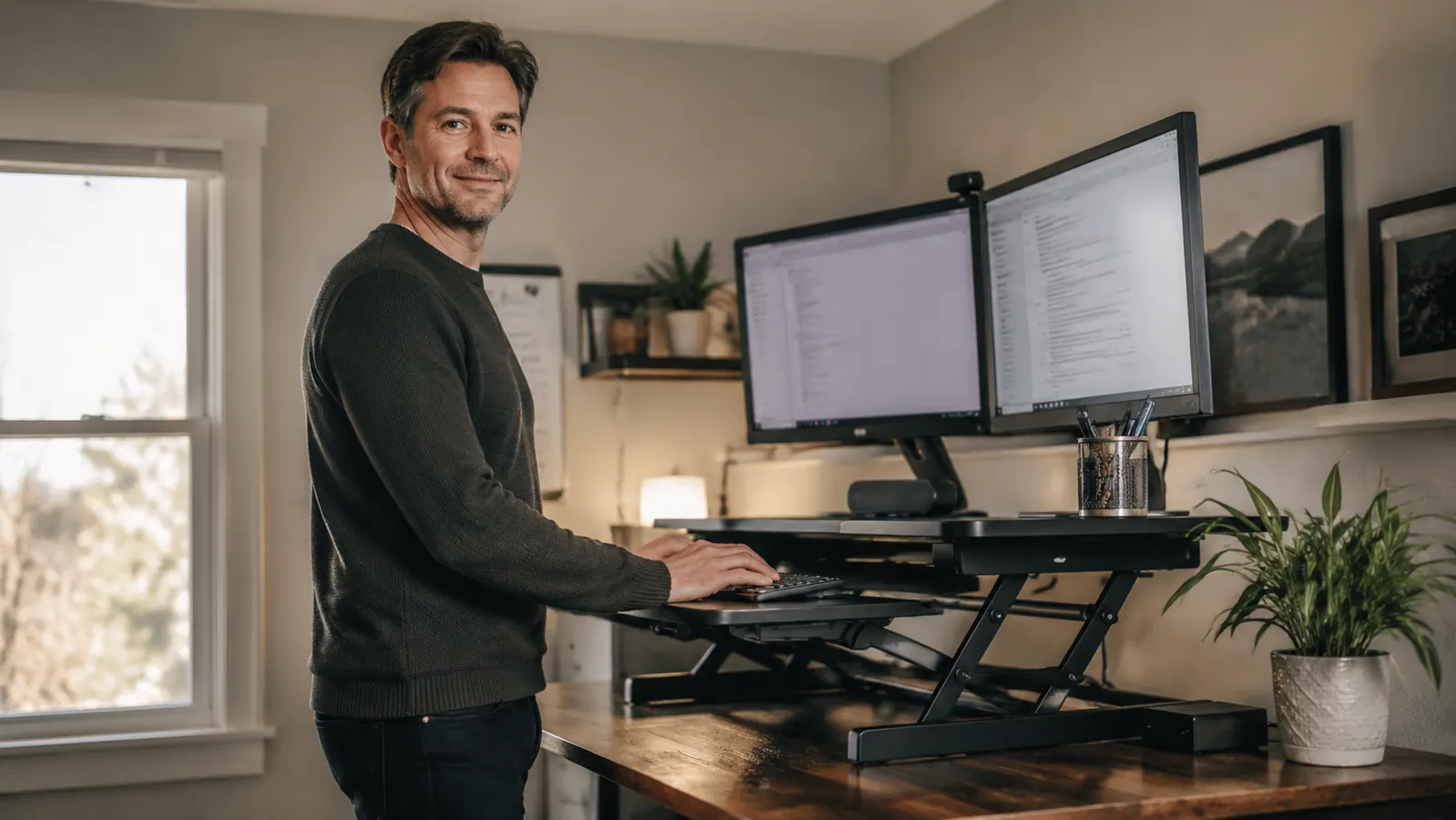
For about three years, I kept a sticky note on my monitor that said 'STAND UP.' It was a cheerful little reminder that I ignored completely. I would sit down at 8 a.m., look at it, think 'good idea,' and then stay seated until my lower back started making its feelings known around 2 p.m. By that point I was already stiff, already irritable, and already telling myself I would sort out a proper standing setup as soon as I had time to research it. I never had time to research it. The fix, when I finally found it, turned out to be an affordable VIVO desk converter that sits on top of the desk I already owned.
The back tension was not dramatic. It was not a herniated disc or anything that sent me to urgent care. It was the slow, grinding kind, the kind that makes you shift in your chair every 20 minutes and reach for ibuprofen by Thursday afternoon. My chiropractor said the same thing every visit: 'You need to sit less.' I nodded, paid my copay, and went home to sit some more.
At some point I got clever and decided to solve the problem myself without spending money on a converter. I stacked four thick hardcover books under my laptop, added a Bluetooth keyboard, and called it a standing solution. This lasted about a week. The books shifted every time I typed hard. The laptop sat at an angle that made my neck hurt in a brand new way. And there was no comfortable place to put my coffee. I knocked it over twice. After the second time I took the books off and went back to sitting, this time feeling worse because I had tried and failed.
I want to be honest about why it took me so long to buy an actual converter: I thought I was too practical for it. I had read about people spending serious money on a full electric standing desk, and that felt like a commitment I was not ready to make for a habit I had proven I could not keep. A converter felt like the right middle ground on paper, but I kept second-guessing whether a mid-range piece of equipment would end up being another thing I used for two weeks and then ignored.
The books shifted every time I typed hard. The laptop sat at an angle that made my neck hurt in a brand new way. After the second time I knocked over my coffee I took the books off and went back to sitting.
I finally ordered the VIVO 32-inch K-Series desk converter, ASIN B075JYG2TB, after spending about 45 minutes reading through reviews from people who described my exact situation: small home office, no room for a full standing desk, stubborn lower-back tension, previous failed attempts at DIY solutions. The price sat at what I would call honest territory for a tool you plan to use every day. It arrived in a single large box, and setup took maybe 20 minutes, which included the time I spent reading the instructions twice because I do not trust myself with anything that has a gas spring.
If the book-stack phase sounds familiar, this is the upgrade that actually works.
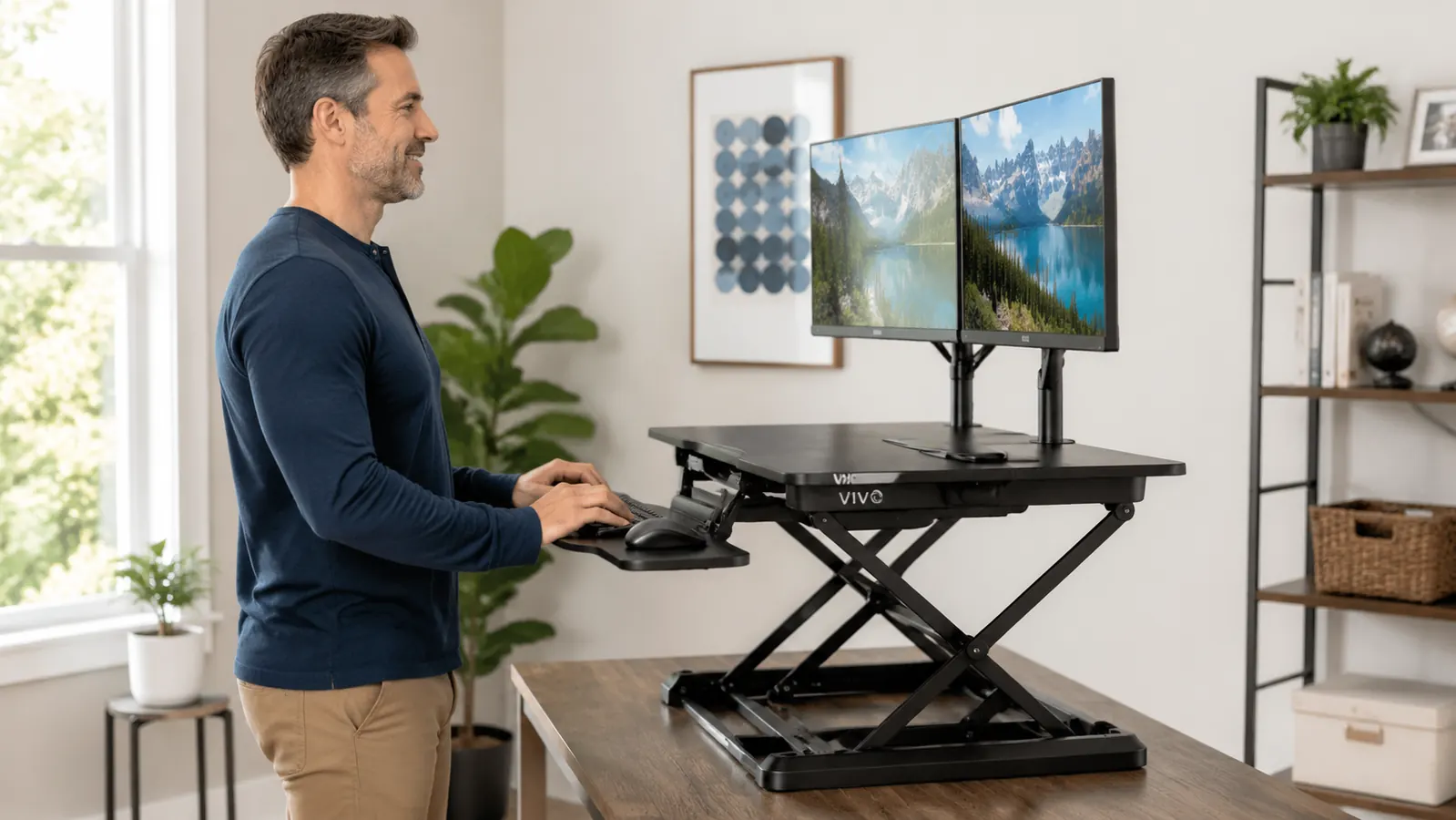
The VIVO 32-inch desk converter holds a monitor and keyboard together, raises smoothly with one hand, and sits stable enough that you stop thinking about it. That is the whole point.
Amazon Check Today's Price on Amazon →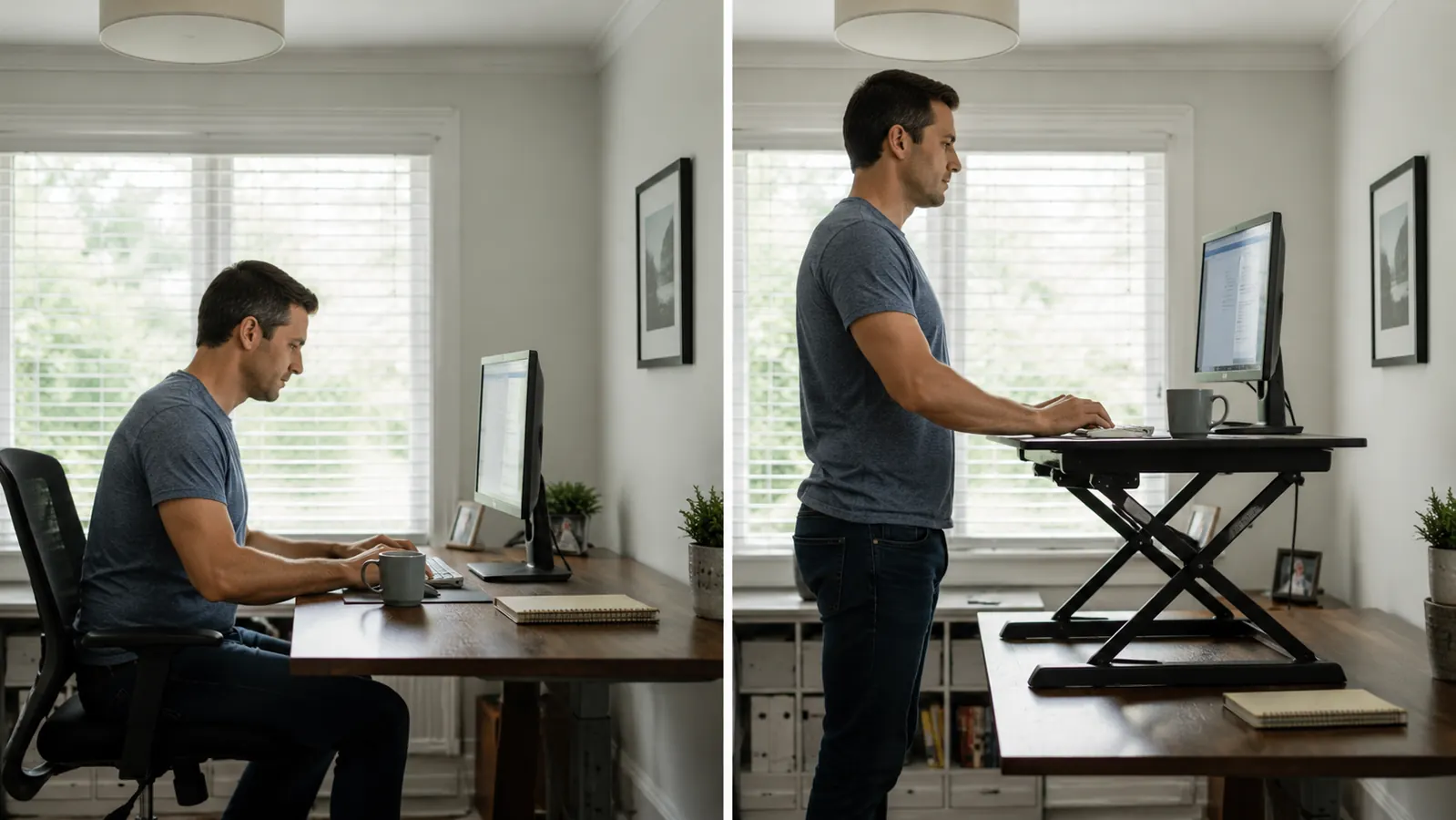
What I did not expect was how different the switching motion would feel. With books you have to make a decision: commit to standing and rearrange everything, or do not bother. With the VIVO, raising and lowering takes about three seconds. You grip the handle under the platform, lift or lower, and it locks at your chosen height. That friction removal turned out to be the whole ballgame for me. I was not lazier than average; I was just using a system where the friction cost was higher than the comfort cost of staying seated. Once those swapped, I started actually standing.
The first week I stood for maybe 30 minutes total per day. That sounds modest, but it was 30 more minutes than the week before. By week three I was doing a natural rotation: seated for focused writing, standing for calls and email, seated again for lunch, standing again for the afternoon stretch where the back tension used to kick in. The 2 p.m. ibuprofen became a once-a-week thing instead of a daily habit.
There are real limitations worth knowing. The keyboard tray on the VIVO is not deep. I have a full-size keyboard with a numpad and it fits, but there is not a lot of extra space for a mouse. I ended up sliding my mouse pad to the side of the tray, which works but is not elegant. At the highest setting there is some wobble if you type hard, which I noticed on the first day and mostly stopped noticing after that. If you type like you are angry at the keyboard it might bother you. It does not bother me.
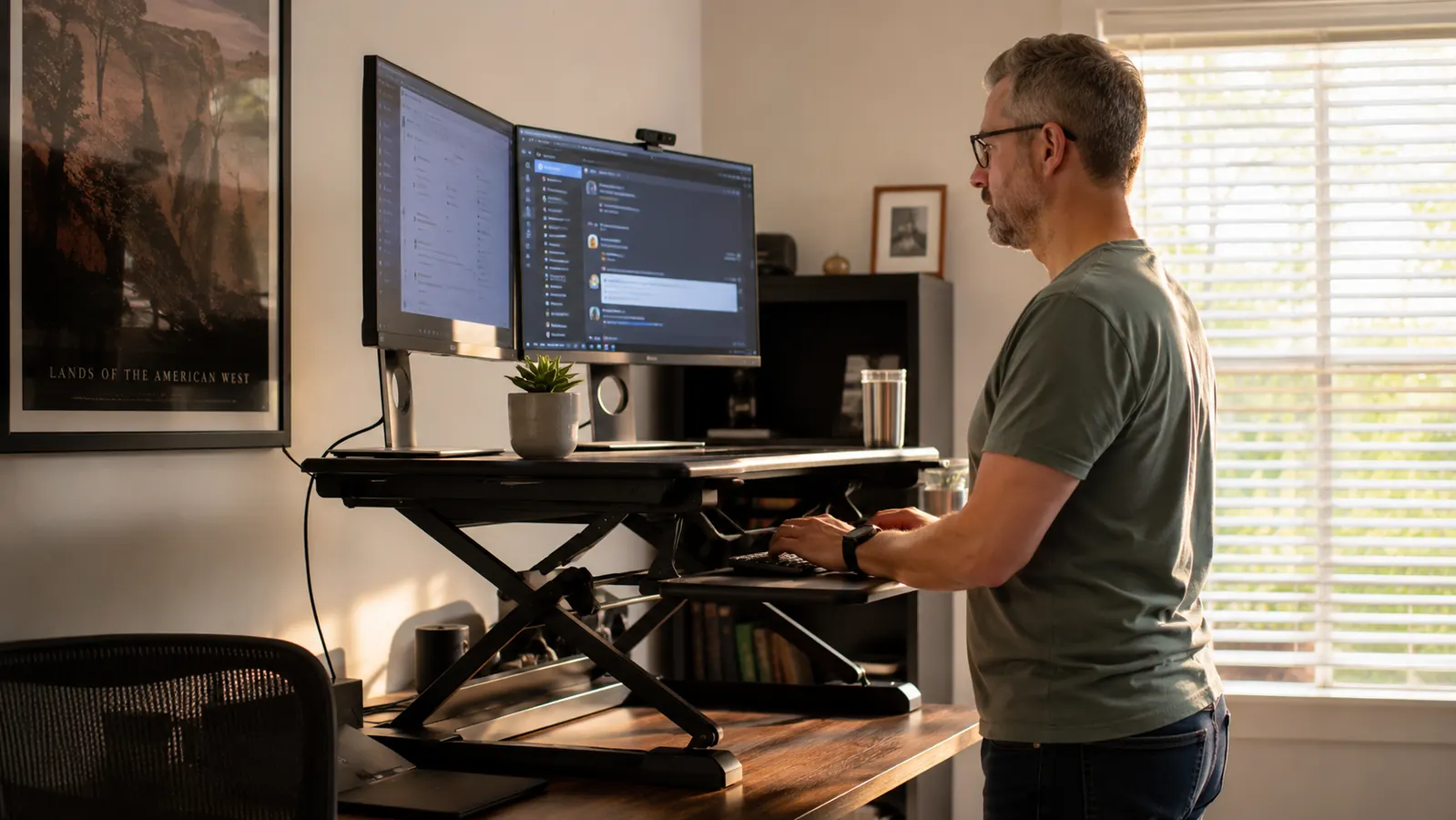
The 32-inch surface holds a single large monitor or two smaller ones side by side. I run a 27-inch monitor plus my laptop in clamshell mode and it fits with a few inches to spare. The build feels solid for the price. The all-black finish is understated enough to disappear into most home offices. I have had it on my desk for about seven months and nothing has cracked, loosened, or needed adjustment.
What I Would Tell You If We Were Sitting at My Kitchen Table
I would tell you to stop waiting until you have time to figure out the perfect setup. I spent three years waiting, and the VIVO cost me a modest amount and about 20 minutes to install. If your back is bothering you and you keep saying you will stand more, this is the thing that removes the excuse. It is not glamorous. It is not an electric motorized desk with memory presets and an app. It is a gas-spring platform that raises and lowers smoothly and stays out of your way the rest of the time. That is exactly what I needed, and it is probably what you need too.
If you are on the fence because you are worried you will not actually use it, I understand that worry completely. My honest answer is that the ease of use is what made the difference for me. When switching takes three seconds and zero rearranging, you do it. When it takes five minutes and involves moving your coffee and finding your keyboard again, you do not. Buy the thing that makes the good habit easy. That is the whole argument.
One more thing: pair it with a decent anti-fatigue mat if you plan to stand more than 30 minutes at a stretch. Standing on hardwood for an hour is its own kind of discomfort, and a good mat takes care of it. I cover that separately in my review of the Ergodriven Topo, but any mat with real cushion is better than none. The converter gets you off your chair. The mat makes you want to stay off it.
Seven months in, the sticky note is gone and so is the 2 p.m. back tension.
The VIVO 32-inch desk converter is the straightforward, no-drama solution that finally got me standing during the workday. If that is the result you are after, this is where I would start.
Amazon Check Today's Price on Amazon →