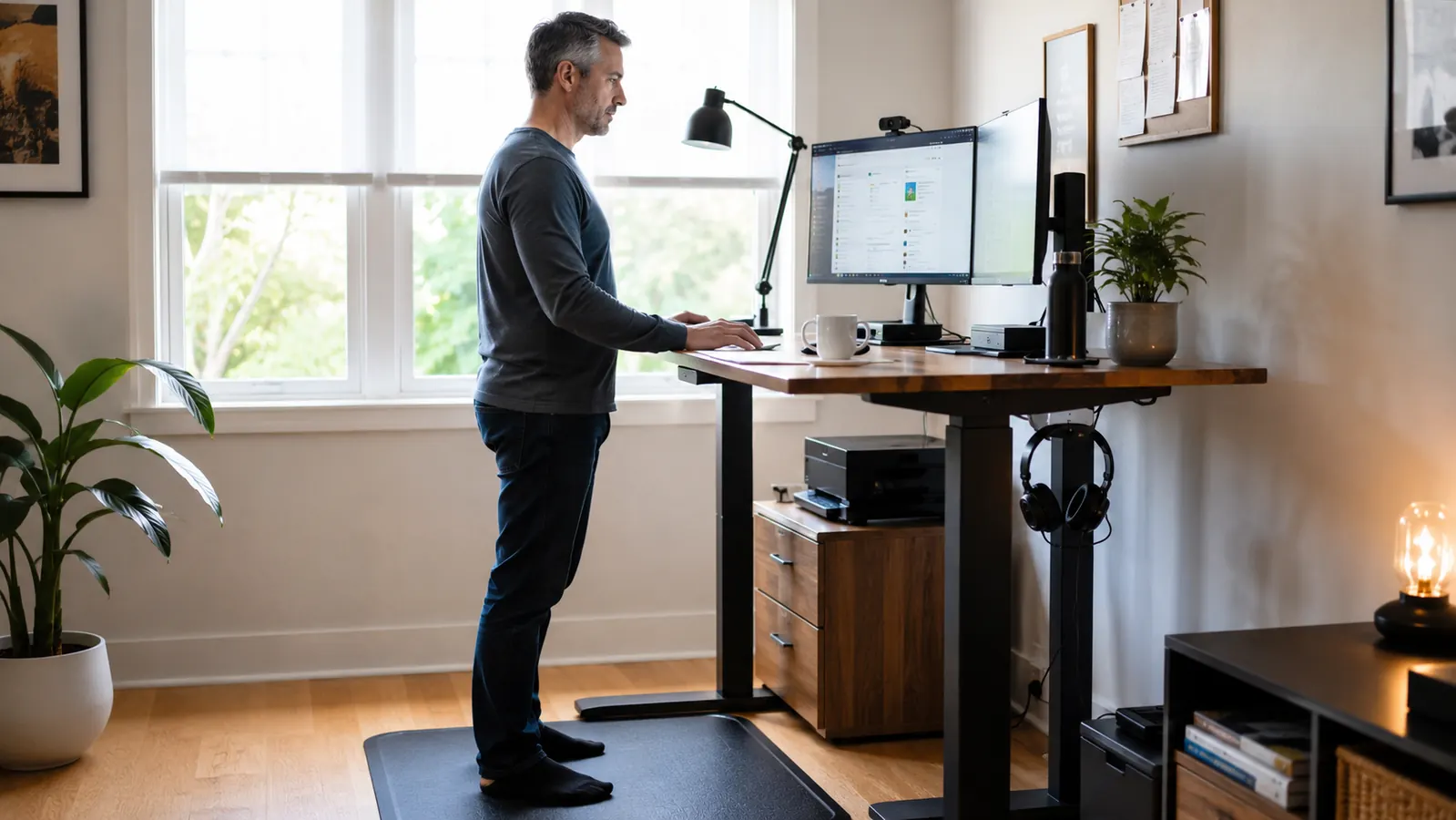
I bought my first standing desk in 2021 and quit using it by week three. The problem was not the desk. My feet hurt by noon, my calves ached by 2pm, and by 4pm I was sitting again and feeling vaguely guilty about it. A physical therapist friend pointed at the obvious thing I had missed: I was standing on thin carpet over concrete slab, and no amount of height adjustment was going to fix that. The mat I eventually bought, the Ergodriven Topo, changed the whole equation. I have been standing on it every working day since, and the standing desk I almost returned is now the piece of gear I point to when someone asks what made the biggest difference in my home office.
If you have a standing desk or are thinking about getting one, the mat is not an optional accessory. It is the foundation that makes the whole setup work. Here are the ten specific reasons I say that, drawn from a year of standing on the Topo for four to six hours a day in a home office where I write for a living.
Still standing on hard floor? Your feet already know the fix.
The Ergodriven Topo is the mat that gets remote workers back to standing after a flat mat let them down. Check today's price before reading on.
Amazon Check Today's Price on Amazon →It Turns Passive Standing Into Active Standing
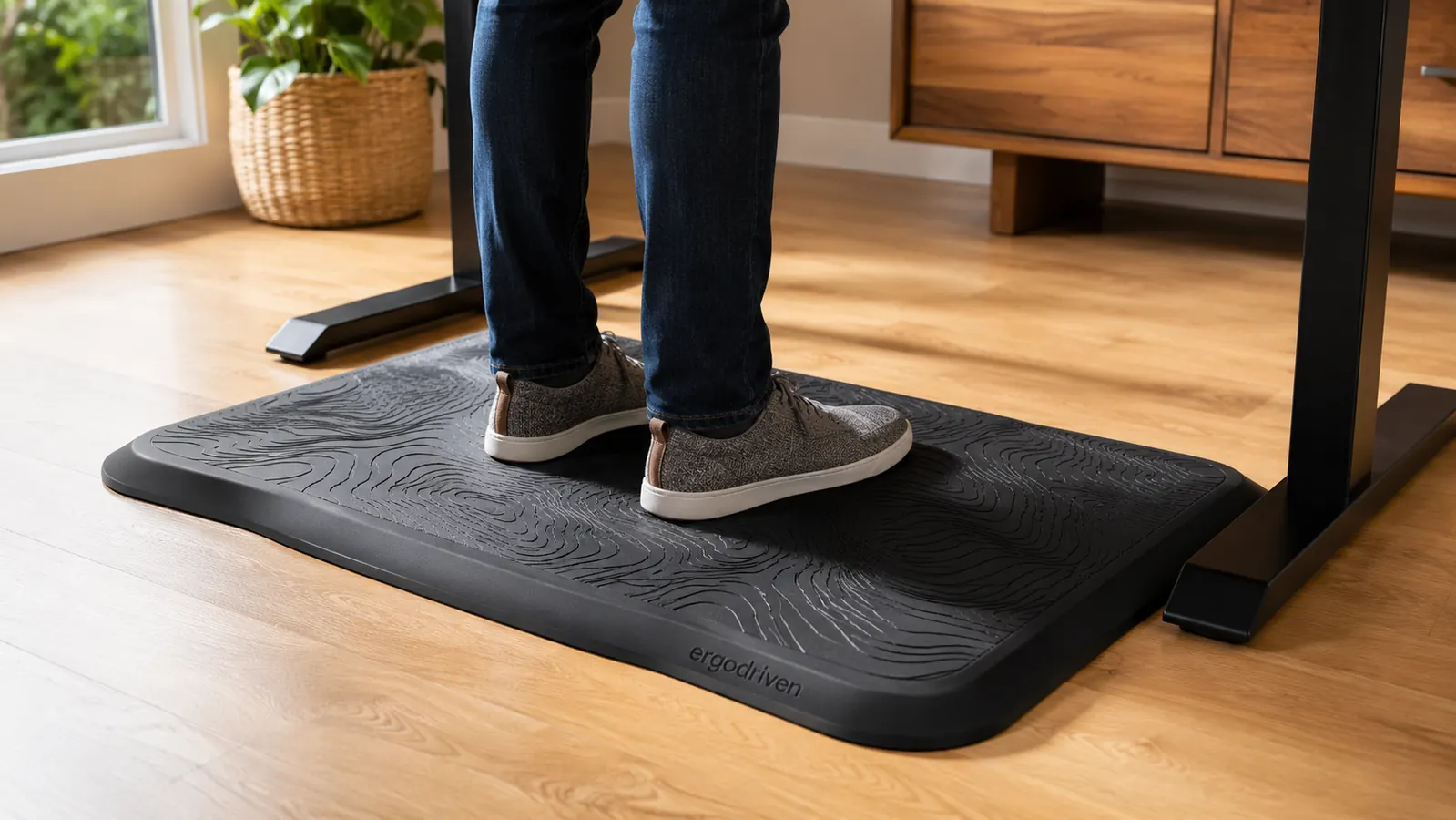
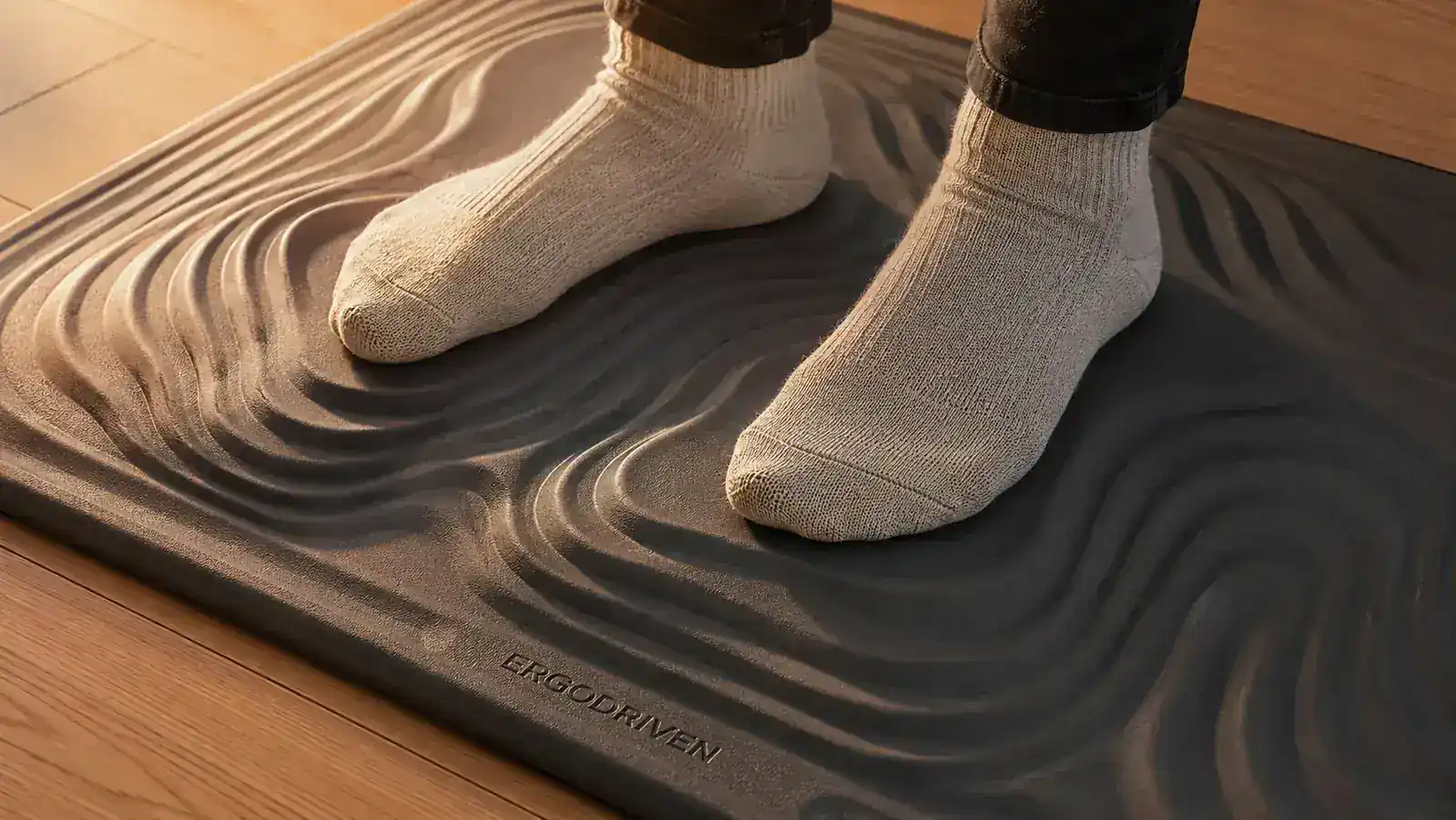
A flat mat cushions your feet. The Topo's contoured surface, with its raised center mound and sloped perimeter, gives your feet somewhere to go. You shift weight without thinking about it. That constant small movement activates your calf muscles and glutes in a way that flat standing never does. After my first week on the Topo I noticed my calves were noticeably less cramped at the end of the day, and I was not consciously doing anything differently. The mat was doing the work.
It Reduces the Fatigue That Drives You Back to Your Chair
The number one reason people stop using standing desks is that standing hurts. Hard floor plus thin carpet is essentially concrete from your joints' perspective. The Topo's polyurethane foam compresses under load and rebounds when you shift position, absorbing the static compression that builds up in your arches, heels, and knees over a long session. I can stand for ninety minutes on the Topo and feel about the same as I did after thirty minutes on my old flat mat. That one change made my sit-stand schedule actually stick.
It Holds Up Without Going Flat
Cheap foam mats compress permanently after a few months of daily use. You end up with a thin wafer that does almost nothing for cushioning. The Topo uses a denser foam formulation than most budget mats, and after a year of daily use mine looks and feels essentially the same as when it arrived. The raised center mound has not collapsed. The beveled edges have not crumbled. I can still feel real give under my heels when I step on it. Durability matters because the whole value of the mat depends on it working six months from now, not just the first week.
It Gives Your Feet a Stretch Break Without Leaving Your Desk
The raised mound at the center of the Topo acts as a passive foot massager and calf stretch when you plant your toes on it and lower your heel toward the floor. I do this without planning to, usually when I am reading something long on screen. It is the kind of micro-movement that breaks the static load before it turns into ache. A flat mat gives you nowhere to do this. The terrain is the feature.
It Protects Your Floor Without Sliding Around
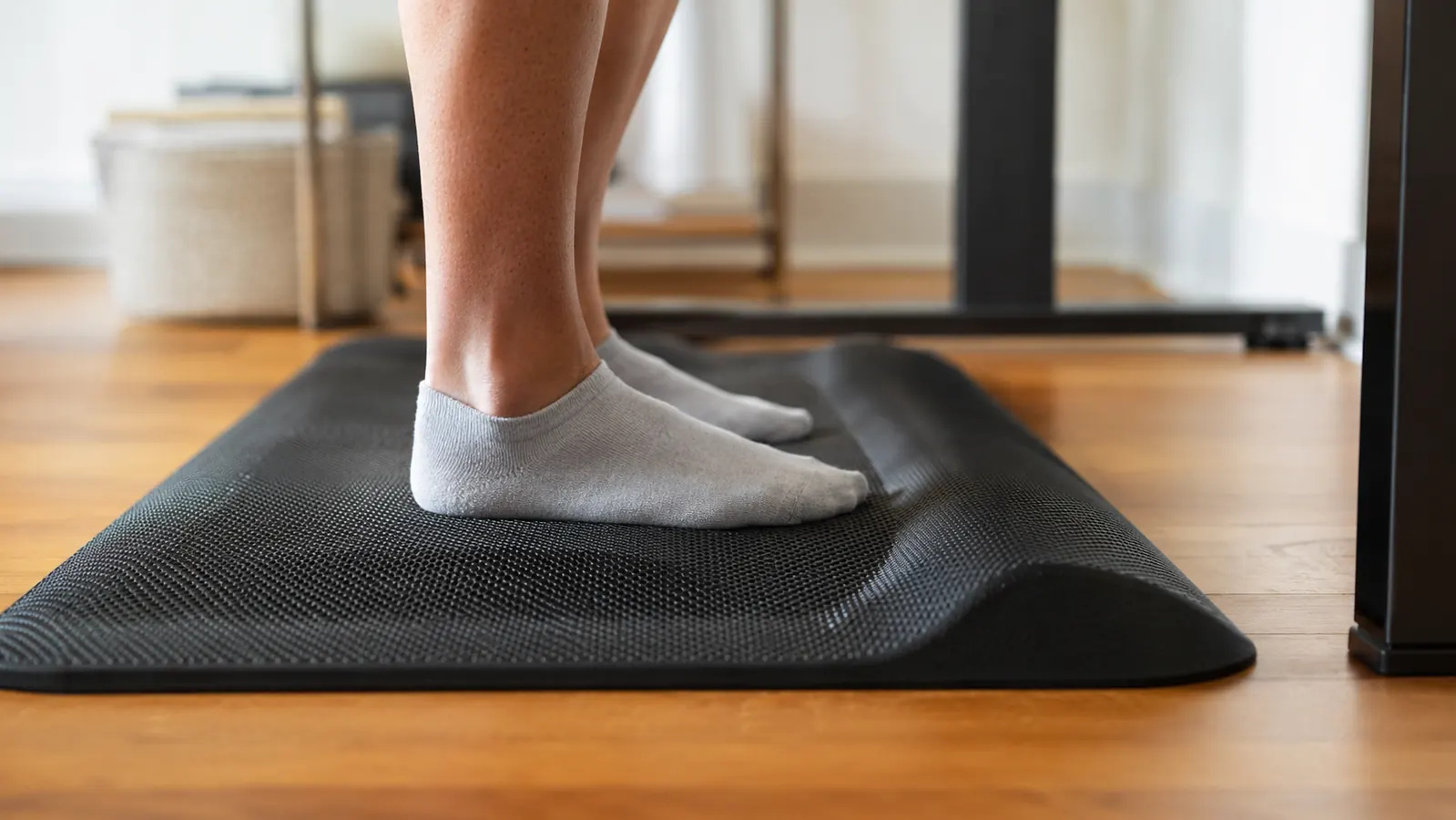
The Topo has a textured non-slip base that grips both hardwood and tile without adhesive. I have mine on engineered hardwood and it has never crept away from the desk, even when I am shifting around a lot. The beveled edges mean I do not catch my socked feet on a lip and stumble. For hard floors, that stability is also protecting the finish, since the base material does not react with polyurethane coatings the way some rubber mats do.
The mat I almost skipped turned out to be the piece of gear that made every other standing desk decision irrelevant. Without it, the desk was just an expensive guilt machine.
It Makes the Transition From Sitting to Standing Feel Like Less of a Chore
One underrated psychological barrier to using a standing desk is that standing feels like work, while sitting feels like rest. When your mat makes standing comfortable and keeps your body subtly moving, that mental resistance drops. I noticed this around week three with the Topo. Switching to standing stopped feeling like a minor act of discipline and started feeling like a neutral preference. That sounds small but it is the difference between a standing desk you use and one you prop things against.
It Is Sized Right for a Single-User Standing Zone
The Topo comes in two sizes. I have the standard, which measures 26 by 29 inches, and it fits perfectly in the standing footprint of my 60-inch desk without feeling cramped or overflowing into the area where my chair rolls when I sit. Getting the size right matters because a mat that is too small means your heels drift off the edge, and a mat that is too large clutters your floor plan. The standard covers two feet comfortably side by side with room to shift. The XL is worth considering if you tend to stand wide or have a larger body frame.
It Works in Bare Feet and Regular Shoes
Some standing mats feel fine in shoes but are uncomfortably firm in bare feet, or they grip socked feet too aggressively when you try to shift position. The Topo's surface texture is fine enough that it does not snag socks, and the foam is soft enough to use comfortably without shoes. I alternate between barefoot mornings and sneakers in the afternoon depending on whether I am staying at my desk or moving around the house, and the mat handles both without complaint.
It Costs Less Than One Month of Sitting-Related Back Pain
This one requires honesty rather than hype. The Topo is not cheap as anti-fatigue mats go. There are flat foam mats on Amazon for a fraction of the current price. But I went through two of those flat mats in the year before I bought the Topo, and both went soft and useless within six months. The Topo, at a higher upfront cost, has outlasted both of them combined and is still doing its job. The math only pencils out if you think of it as a one-time purchase rather than a recurring expense, and so far, one year in, it has been exactly that.
It Signals That You Are Serious About the Habit
This is the least tangible reason on the list and probably the most true. Setting up your standing zone properly, with a mat that is genuinely designed for the purpose, changes how you treat the habit. I think of my standing desk as a real part of my workday now, not a novelty I paid too much for. The mat is a big part of why. It is the difference between a makeshift setup you halfheartedly try and a proper workstation you actually use.
What I Would Skip
If you are testing whether you will actually use a standing desk at all, start with a cheaper flat mat. Spending a significant amount before you know the habit will stick is a reasonable risk to avoid. But if you have already proven to yourself that you want to stand and your feet are what keep driving you back to the chair, the flat mat upgrade cycle gets expensive fast. At that point the Topo is the better long-term buy. I would also skip the gel-filled mats that some brands sell. They feel great on day one and feel like standing on a half-deflated balloon by month four.
Two flat mats in twelve months taught me more about anti-fatigue mat durability than any review I read. The Topo was the one I did not have to replace.
Your standing desk is only as good as what you stand on.
The Ergodriven Topo is rated 4.7 stars across nearly 6,000 reviews. It is the mat I use every working day and the one I point every remote worker to when they ask what is missing from their standing setup.
Amazon Check Today's Price on Amazon →