

I started standing at my desk in the fall of 2023 because my lower back had turned every afternoon into a countdown until I could lie on the floor. I had the converter. I had the monitor arm. What I did not have was a mat that made standing feel sustainable. My first mat was a flat rectangle of memory foam I found on sale for about eighteen dollars. I stood on it, my feet still ached by 2 pm, and I decided the problem was me. It was not me. The problem was the mat. I bought the Ergodriven Topo about twelve months ago, and I have stood on it every working day since. Here is what a year of honest daily use actually looks like.
The Quick Verdict
The Topo is the best standing mat I have used, and the contoured surface genuinely reduces foot fatigue compared to a flat mat. It is expensive for what it is, the raised dome takes a few days to feel natural, and it is not magic. But after a year it is still doing its job, it has not compressed flat, and I have not gone back to sitting all day.
Amazon Check Today's Price →If foot fatigue is the reason you stop standing before 2 pm, this mat is worth a serious look.
The Ergodriven Topo is the standing mat I have used daily for a year and still recommend. It is priced higher than the flat foam alternatives, but the contoured surface is the reason I actually keep standing. Check the current price before it changes.
Amazon Check Today's Price on Amazon →How I've Used It
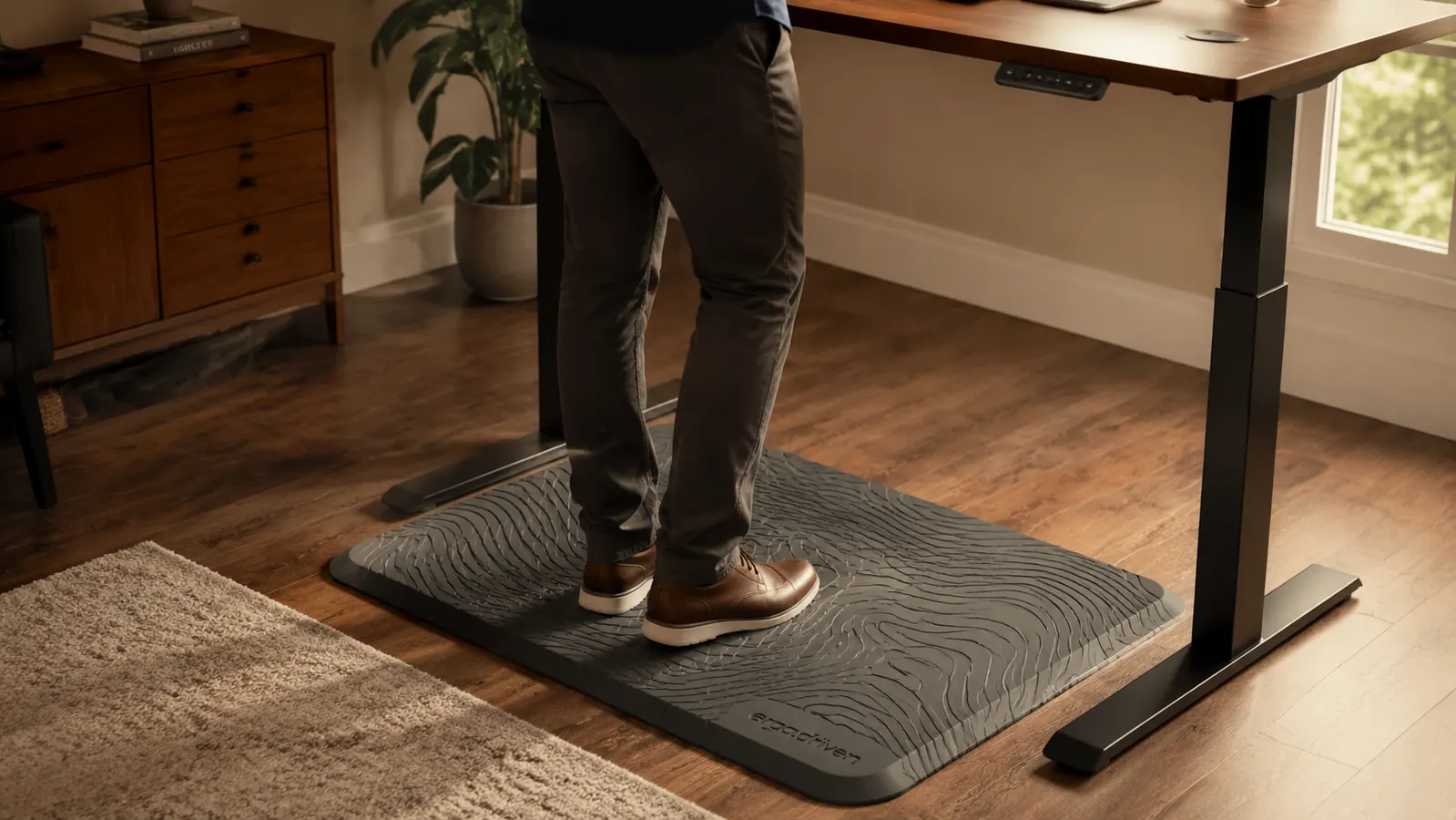
My setup is a VIVO desk converter on a 60-inch Ikea desk. I stand in the mornings, sit after lunch, and usually get back on my feet for a second standing block in the late afternoon. On a normal writing day that is somewhere between two and three hours of total standing time. I wear socks, no shoes, on the mat. My home office has hardwood floors throughout, which means standing fatigue hits faster than it would on carpet or rubber flooring.
I did not do anything special to break in the mat. I pulled it out of the box, positioned it in front of my converter, and started using it the same day. The first thing I noticed was that it smelled noticeably of rubber for about four or five days. That faded completely by day six. The second thing I noticed was that I was not sure what to do with the raised center dome. My instinct was to put one foot on it and one foot flat on the mat. That turned out to be exactly right.
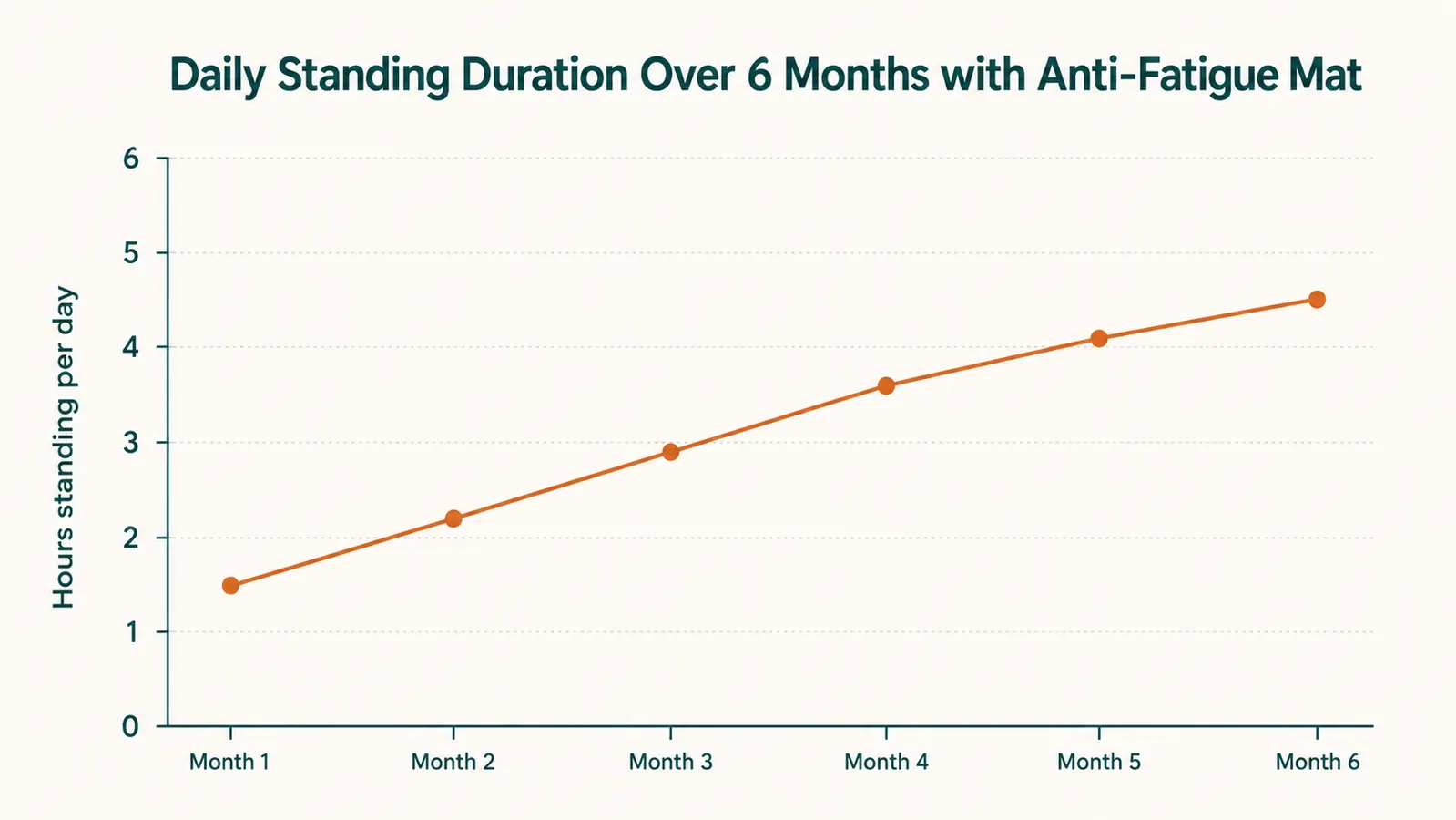
For the first week I kept stepping off it to adjust my position, which told me my feet were still looking for the right place to land. By week two I was shifting weight naturally without thinking about it. By month two I stopped noticing the mat at all in the conscious sense, which is exactly what you want from a piece of ergonomic equipment.
What the Contoured Surface Actually Does
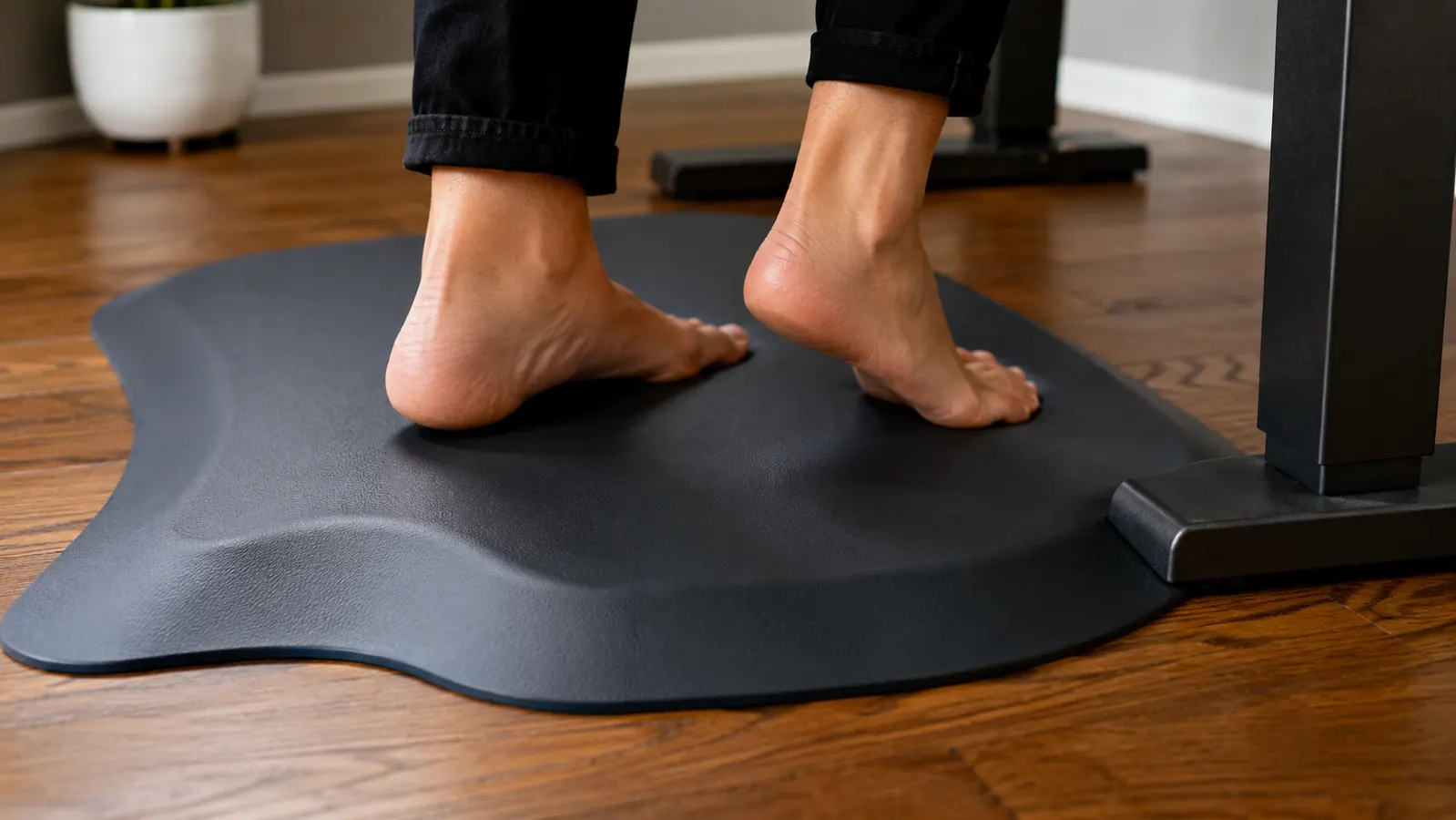
The Topo's defining feature is its topography: a raised dome in the center, two sloped side ridges, and a slightly angled surface at the far end. The idea is that instead of standing static on a flat surface, your feet have somewhere to shift. You step up onto the dome, lean against the slope, shift your weight to one side. The movement is small but constant, and constant micro-movement is what keeps blood circulating through your legs and feet instead of pooling.
I was skeptical that this would matter in practice. It does. On the rare occasions I have used a flat mat since switching, the difference is noticeable within about forty minutes. Flat standing activates the same muscles in the same positions for the entire time you are standing. The Topo quietly rotates which muscles are working. My foot and calf fatigue by early afternoon dropped significantly in the first month and has stayed lower across the full year.
That said, the contoured surface is not a cure for poor standing habits. If you stand for four hours straight without any break, your legs will still complain. The mat lengthens the comfortable window. In my experience it extends the point where I start feeling real fatigue from about 45 minutes on a flat surface to closer to 90 minutes on the Ergodriven Topo.
My foot and calf fatigue by early afternoon dropped significantly in the first month and has stayed lower across the full year. The contoured surface is not a gimmick. It does what the design claims.
Material Quality and Durability After Twelve Months
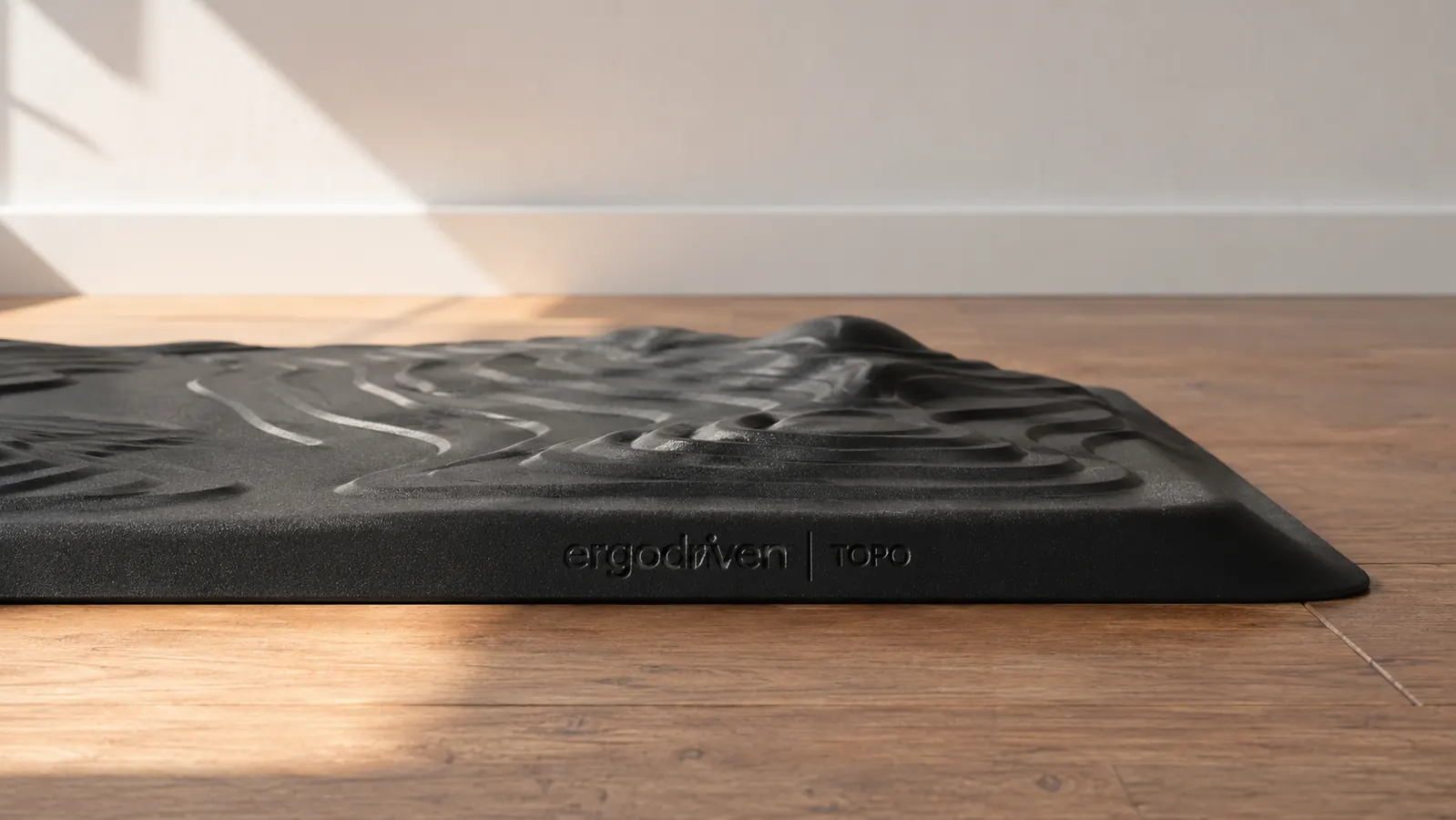
The Topo is made from a polyurethane foam with a textured polyurethane surface. It is not the thick squishy memory foam you get from budget mats, and that is a good thing. Memory foam compresses under pressure and tends to flatten out over months of daily use. The Topo's material is firmer and more resilient. After twelve months of standing on it for two to three hours daily, the dome has not collapsed, the edges have not curled, and the surface texture is intact.
The underside has a textured non-slip surface that has held up well on hardwood. I have never had it slide or shift under my feet. The edges are smooth and finished, not the cut-foam look of cheaper mats, and they have not started to crack or fray. The only visible sign of a year's use is a slight discoloration on the dome from socks. A quick wipe with a damp cloth gets most of it off.
The size works well for a standard standing desk converter. The Topo measures 26 by 29 inches. That gives you enough room to shift laterally without stepping off the mat, but it is compact enough that it does not take over the floor space in front of your desk. I tried the large size briefly at a friend's desk and found the extra width unnecessary for solo use.
The Real Tradeoffs
The price is the obvious one. The Topo costs more than most flat anti-fatigue mats, and several times more than the cheapest options. For people who are not yet sure whether they will stick with standing, that price is a hard ask. If you are testing whether you can make standing at your desk a daily habit, a cheaper flat mat will tell you the answer. Once you know you are going to stand regularly, the Topo is worth the difference.
The raised dome is unusual under your feet if you have never used a contoured mat before. For the first few days it felt slightly unstable, like standing on uneven ground. Some people dislike this and never get past it. I adapted within a week, but I know at least two people who tried the Topo and returned it because they wanted a flat surface. If you strongly prefer stable, level footing, the contoured design may not be for you.
It is also not particularly portable. The Topo is a single rigid piece and while it is not heavy, it is shaped in a way that makes it awkward to carry. If you need a mat that travels with you or lives under a desk that also gets used by others, the rigid topography is less practical than a rollable or flat alternative.
What I Liked
- Contoured surface genuinely reduces foot and calf fatigue compared to flat mats
- Durable material has not compressed or flattened after twelve months of daily use
- Non-slip underside has never moved on hardwood floors
- No odor after the first week
- Compact footprint fits a standard converter setup without taking over the floor
- Encourages natural micro-movement without requiring conscious effort
Where It Falls Short
- Price is significantly higher than flat anti-fatigue mats
- Raised dome takes a few days to feel normal and some people never adapt to it
- No portable or rollable format if you need to move it regularly
- Does not eliminate fatigue from prolonged static standing without any breaks
- Dome area shows sock discoloration over time that requires wiping down
How It Compares to Flat Anti-Fatigue Mats
I used three flat mats before the Topo. The first was the cheap memory foam rectangle I mentioned. The second was a commercial-grade flat mat borrowed from a restaurant-supply store, which was denser and more supportive but still flat. The third was an Amazon-brand anti-fatigue mat that runs significantly cheaper than the Topo.
Each flat mat was better than nothing. But none of them solved the specific problem of fatigue accumulating in the same spots over time because your feet are locked into the same position. The Topo solves that. If you want a detailed side-by-side breakdown of the Topo against the Amazon Basics mat with specific durability and price data, the comparison article covers it in full.
The short version: flat mats are a reasonable starting point if you are not sure about standing, and they are fine for people who stand less than an hour a day. For daily users who stand in two-hour blocks, the Topo's contoured design makes a measurable difference in how your feet feel at 4 pm.
Who This Is For
The Topo is best suited to committed daily standing desk users on hard floors. If you work from home on hardwood or tile, stand for at least an hour a day, and have already tried a flat mat and found it insufficient, this mat will likely solve the problem you have. It is also a good fit if you are building a standing desk setup from scratch and want to buy the right mat once instead of upgrading twice. The durability over twelve months of heavy use suggests this is a multi-year purchase, not a consumable.
Who Should Skip It
If you are still in the stage of testing whether you will actually stand at your desk, start with a less expensive flat mat. The Topo's price is only justified by regular daily use. If you stand on carpet, the cushioning you are already getting from the carpet changes the calculus considerably and a cheaper mat may be entirely sufficient. If you have a strong preference for level, stable footing under your feet and found my description of the dome off-putting, there are excellent flat mats that will serve you better. And if you need something portable or shared across workstations, the Topo's single-piece rigid design is the wrong format.
Twelve months later, the Topo is still the first thing I step onto when I raise my desk.
I have not replaced it, have not looked for a replacement, and recommend it to anyone who asks about standing mats. If you are a daily standing desk user on hard floors, check the current price and see if it fits your budget. It is the mat I would buy again without hesitating.
Amazon Check Today's Price on Amazon →