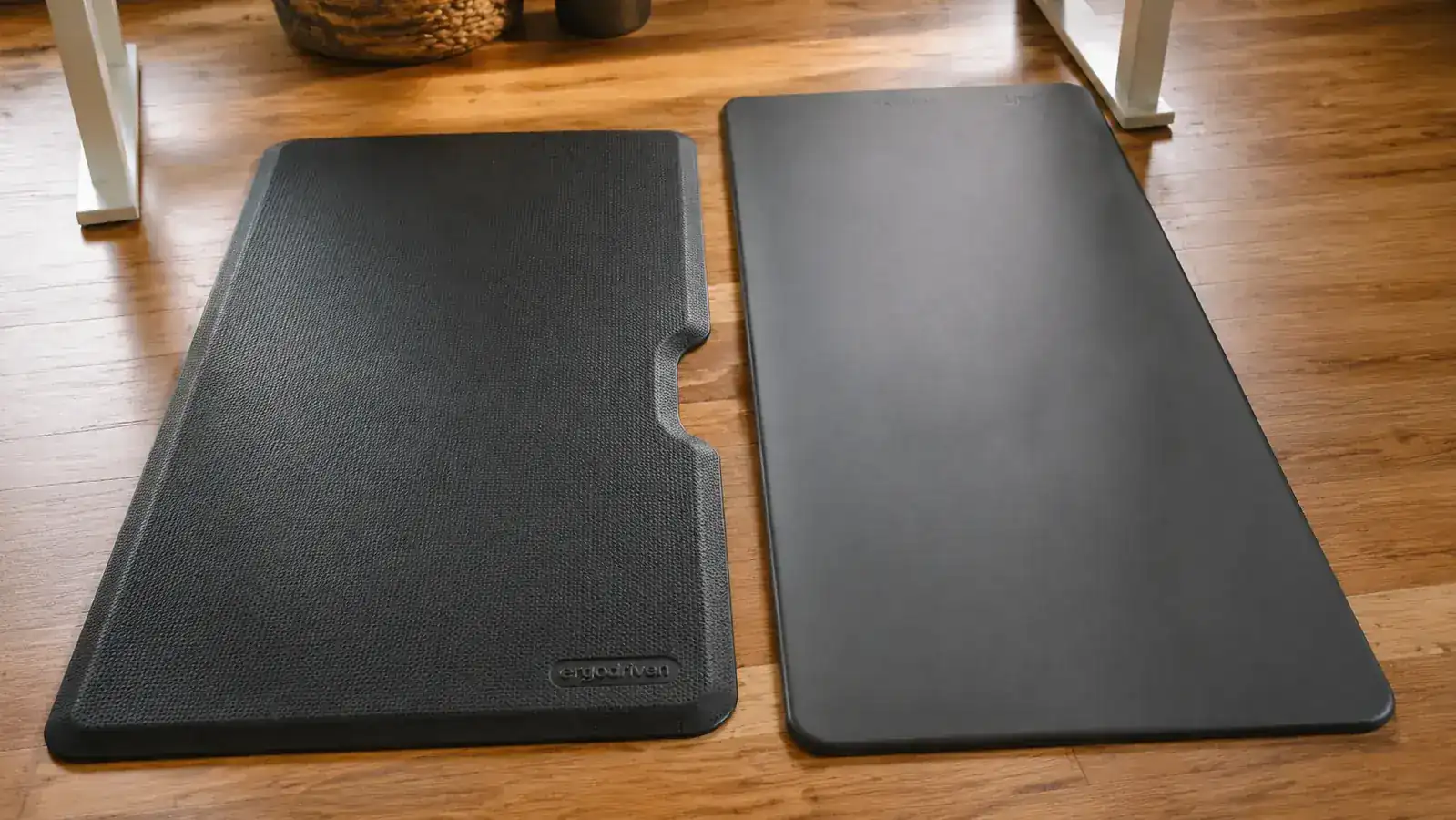
If you have a standing desk and you are shopping for an anti-fatigue mat, you will run into this fork in the road quickly: the Amazon Basics mat at roughly thirty dollars, or the Ergodriven Topo at around a hundred and twenty-nine. Both promise to reduce foot and leg fatigue. Both are thick foam. On paper, you might wonder why anyone would pay four times as much for something you stand on.
I stood on both. The Amazon Basics mat lived under my desk for about two months before the Topo arrived. I kept a log of how my feet and calves felt at the end of three-hour standing blocks, because that is the only honest way to compare something like this. Here is what I found, and who each mat actually suits.
| Ergodriven Topo | Amazon Basics Anti-Fatigue Mat | |
|---|---|---|
| Price | Check today's price on Amazon | Mid-range pricing |
| Surface Design | Contoured with raised terrain, toe bar, and slopes | Flat, level surface throughout |
| Foam Thickness | 3/4 inch at base, raised areas up to 1.5 inches | 3/4 inch flat throughout |
| Footprint (Large) | 26 x 29 inches | 24 x 36 inches (standard large) |
| Foot Movement Encouraged | Yes, terrain prompts shifting and weight changes | No, flat surface does not prompt movement |
| Beveled Edges | Yes, gently tapered all around | Yes, standard bevel on perimeter |
| Durability (Daily Use, 6+ Months) | Retains shape, no compression memory visible | Noticeable compression in high-contact zones by month 3 |
| Best For | Standing 2+ hours daily, foot fatigue a real concern | Occasional standing, budget-first buyers |
| Amazon Rating | 4.7 stars / 5,933 reviews | 4.4 stars / high volume |
Where the Ergodriven Topo Wins
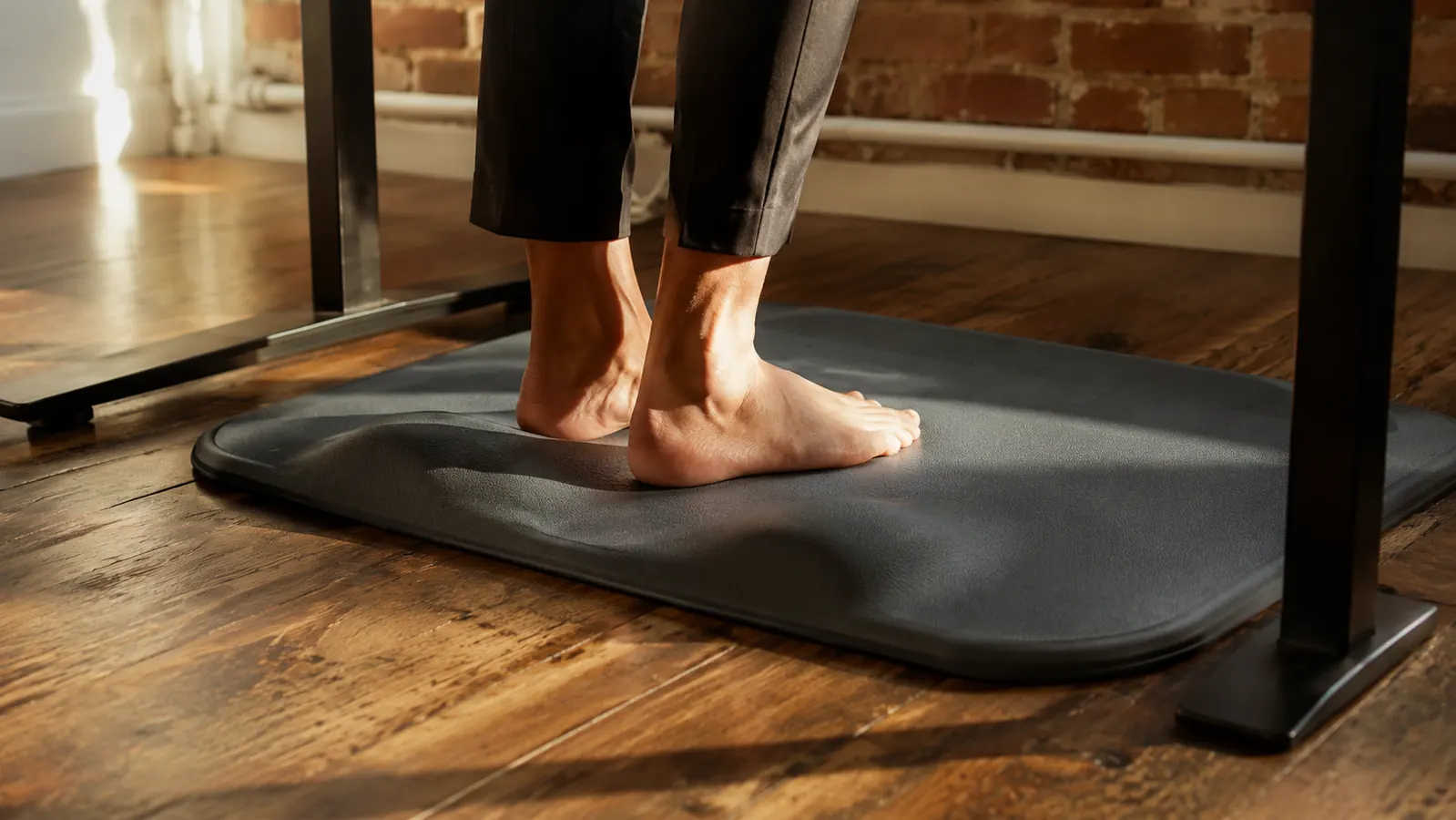
The Topo's design premise is simple and it actually works: a flat mat gives your feet a single position to lock into, which means your calves and lower back carry a static load for the entire standing session. The Topo's raised ridges, sloped edges, and central toe bar force small, constant weight shifts. You end up repositioning your feet every few minutes without consciously deciding to. That micro-movement is the real product.
After three-hour standing blocks on the Topo, the calf tightness I used to feel by hour two was noticeably reduced. My feet were not sore in the same concentrated ball-of-foot way. The toe bar in particular was something I dismissed as a gimmick until I started using it while reading long documents. Pressing into it slightly shifted my weight back and straightened my lower spine. That sounds minor until you have done it a hundred times across a workweek.
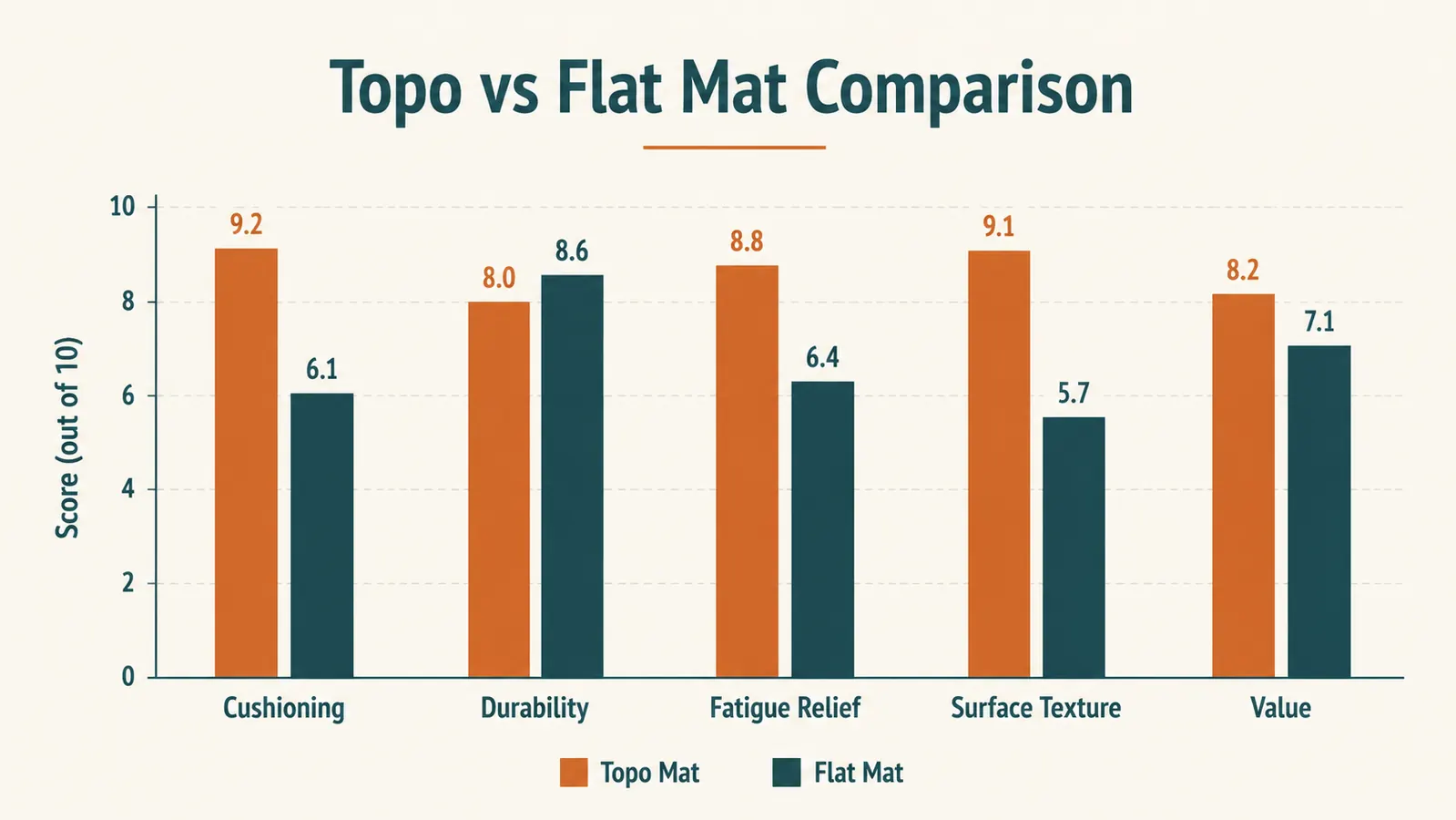
Durability is also a genuine differentiator. After six months of daily use, the Topo shows almost no compression in any of its raised sections. The foam has a high-density feel that the Amazon Basics mat does not match. If you are standing four or five days a week, the Topo is likely to outlast two or three Amazon Basics mats. That math narrows the price gap considerably.
Still standing on a flat mat and wondering why your calves are tight by noon?
The Ergodriven Topo's contoured surface keeps your feet moving so fatigue does not pile up. It has a 4.7-star rating from nearly 6,000 verified buyers, most of them daily standing-desk users.
Amazon Check Today's Price on Amazon →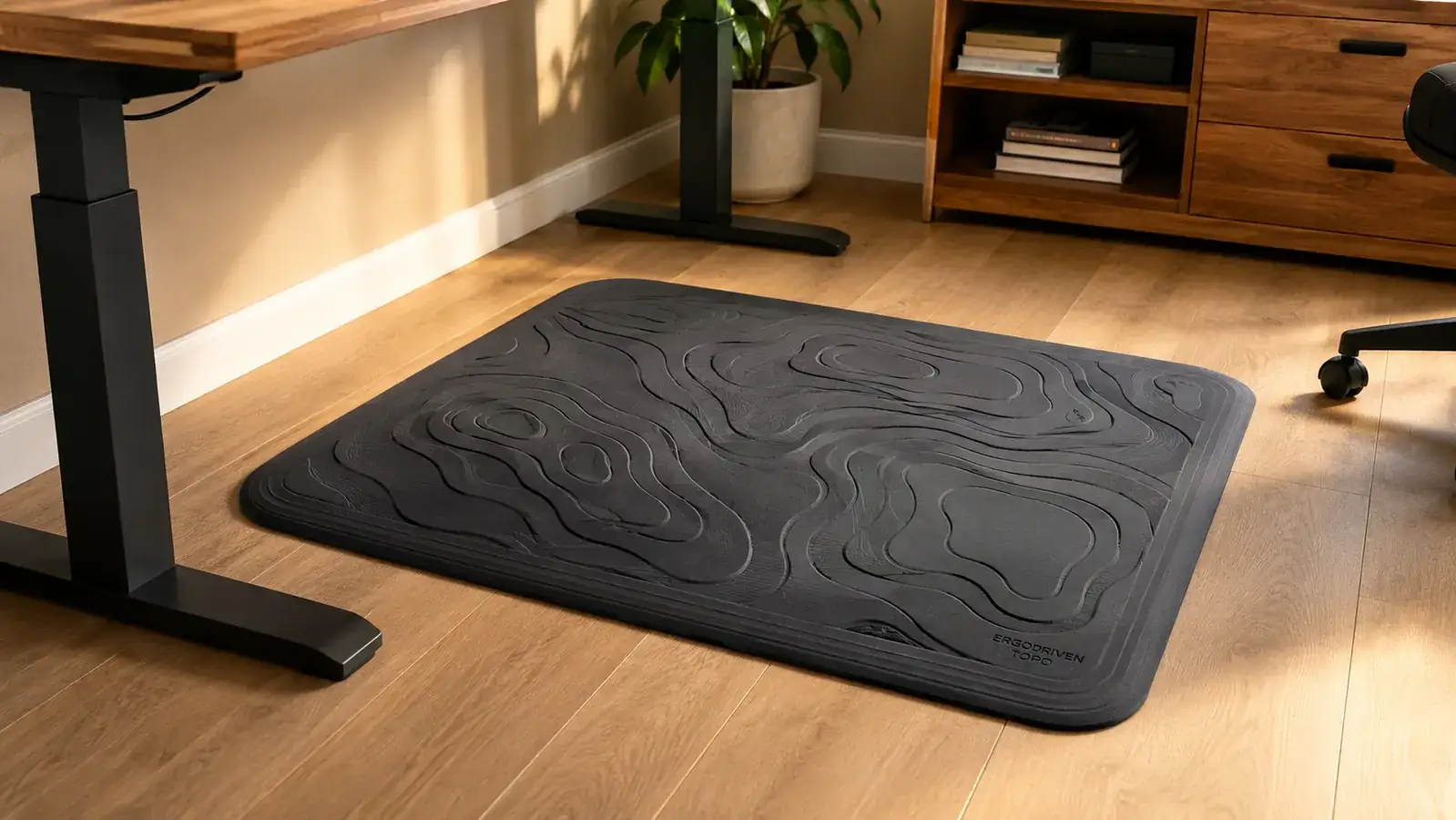
Where the Amazon Basics Mat Wins
The Amazon Basics mat is not bad. For someone who stands in thirty-minute bursts or uses a standing desk casually, it does exactly what a flat anti-fatigue mat is supposed to do. The cushioning is real. Standing on it versus standing on a bare hardwood floor is a meaningful improvement. The bevel edges are clean, it lies flat without curling, and the surface is easy to clean.
It also covers more floor space in its standard large format at twenty-four by thirty-six inches versus the Topo's twenty-six by twenty-nine. If you are using it at a kitchen counter for meal prep as much as a standing desk, the extra length is genuinely useful. And if you are trying to spend as little as possible to test whether standing at all is something you want to commit to, the Amazon Basics mat is a fair place to start before investing more.
The Amazon Basics mat does the job if you stand occasionally. The Topo changes what standing actually feels like if you do it seriously every day.
The Durability Problem With Flat Foam Mats
This is where the comparison tilts most clearly. Anti-fatigue mats rely on foam that compresses under your weight and then rebounds. Flat mats distribute that compression across a single plane, and the spots where you tend to stand, right in front of your keyboard, carry the majority of your body weight for hours every day. By month three with the Amazon Basics mat, I could see and feel a compression zone in that exact spot. By month five, the middle section was noticeably less cushioned than the edges.
The Topo's terrain design spreads your weight across different surface zones depending on where your feet land. Because the terrain encourages you to shift position, the compression load is distributed more evenly over the entire mat surface. After the same period of daily use, the Topo showed no equivalent breakdown. Its raised zones remained firm and springy. This is not a small difference over a year of use.
What About the Size and Shape?
The Topo is notably compact for an anti-fatigue mat. At twenty-six by twenty-nine inches, it takes up less floor space than most competitors, which is a real advantage in a small home office where desk real estate underneath and around the standing area is limited. The compact footprint also means it does not get caught on chair wheels when you roll back to sit, which was a constant annoyance with the longer flat mat.
The raised terrain does take a few days to get used to. The first time you step onto the Topo and your foot lands on a slope rather than flat ground, it feels slightly odd. By the end of the first week, you stop noticing the terrain consciously and start just noticing that your feet feel better at the end of the day. That adjustment period is short and not uncomfortable, but it is worth knowing about so you do not return the mat after two days and conclude it is not for you.
Who Should Buy Which
Buy the Ergodriven Topo if you stand for two or more hours per day most workdays, if you have had calf tightness, foot fatigue, or lower-back stiffness from standing in a fixed position, or if you want a mat that will actually hold up over one to two years of daily use. The price is real, but so is the difference in how your legs feel by the end of an eight-hour workday that includes serious standing time.
Buy the Amazon Basics mat if you are new to standing desks and want to try mat-assisted standing without committing to a hundred-dollar purchase, if you stand occasionally rather than for extended daily blocks, or if you need a wider coverage area for multiple standing positions. It is a reasonable first mat. Just know that if you get serious about standing, you will likely upgrade within a year.
If you are on the fence and already know you want to make standing part of your regular workday routine, skip the intermediate step. The Topo is the better long-term investment and the legs-at-end-of-day difference is real enough to justify the cost.
Ready to stand longer without paying for it with sore feet and tight calves?
The Ergodriven Topo has earned its reputation among daily standing-desk users with nearly 6,000 reviews and a 4.7-star average. Check the current price and available sizes on Amazon.
Amazon Check Today's Price on Amazon →