
I spent the first two years of remote work wondering why I felt worse at the end of the day than I did commuting to an office. Sitting at a desk for eight hours felt like it should be easier on my body than standing on a train. It was not. The culprit was my laptop sitting flat on the desk, forcing my neck down and forward every time I looked at the screen. Once I propped it up on the Lamicall adjustable stand, the end-of-day stiffness dialed back within a week. The stand costs under forty dollars. I want to be clear about that so the math lands: a forty-dollar aluminum riser solved a problem I had spent real money on chair upgrades trying to fix.
If you are still working flat-on-desk, here are ten reasons a laptop stand belongs on your desk right now. Every one of them comes from months of real daily use, not spec sheets.
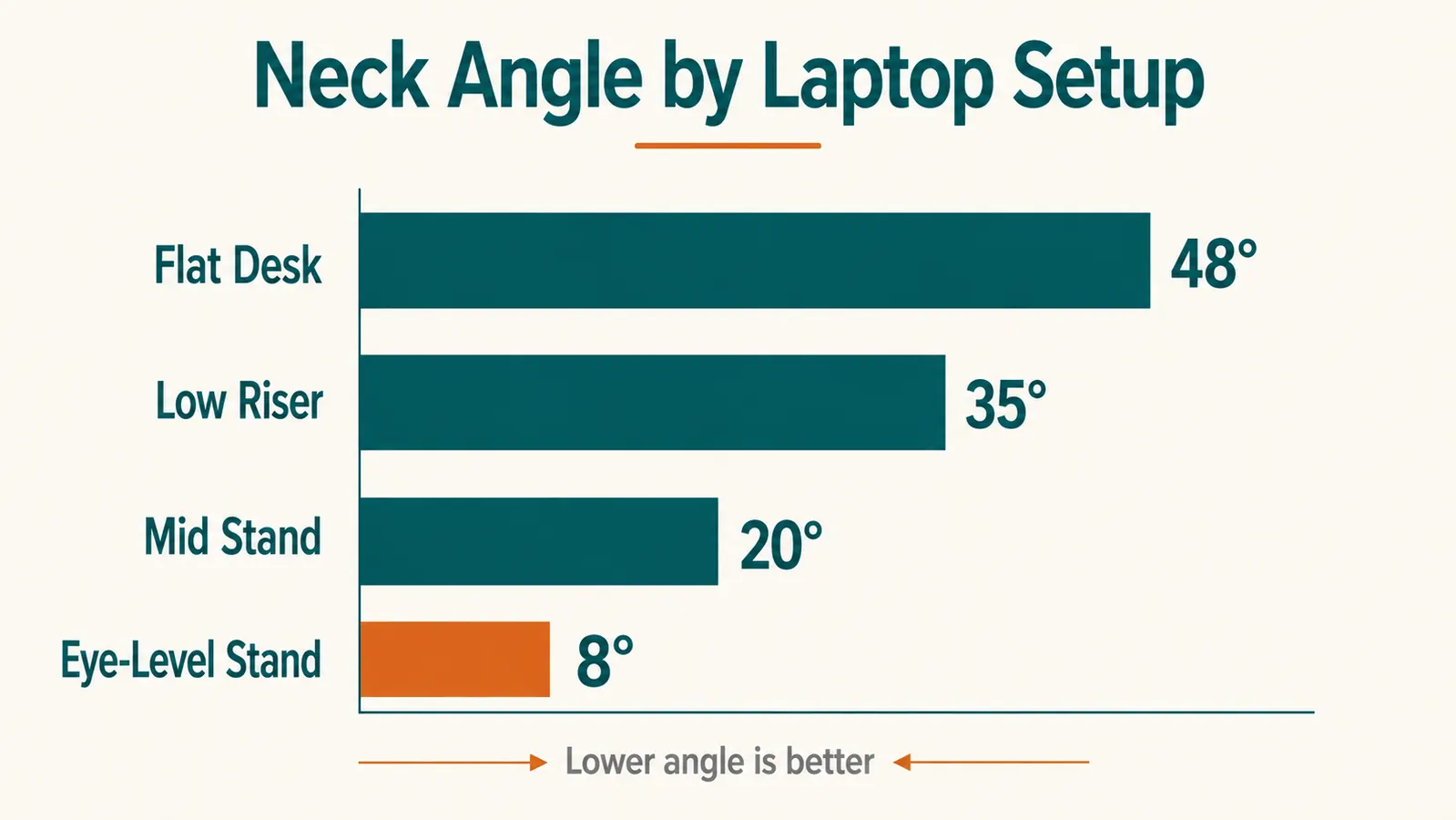
Your neck is down 45 degrees every time you look at that screen. Fix it for under forty dollars.
The Lamicall adjustable laptop stand holds 10 to 17-inch laptops, adjusts to seven height positions, and ships with silicone pads that actually grip. Rated 4.8 stars from over 10,000 verified buyers.
Amazon Check Today's Price on Amazon →It Puts the Screen at Eye Level, Where It Belongs
The number-one driver of remote-work neck pain is screen height, not posture habits or chair quality. When a laptop sits flat, your head tilts forward and down, putting six times more load on the cervical spine than an upright head position. Raising the screen to eye level with the Lamicall's seven adjustable angles lets your neck sit neutral. Most people feel the difference on day one. It is not a subtle change.
It Forces You to Use a Proper External Keyboard
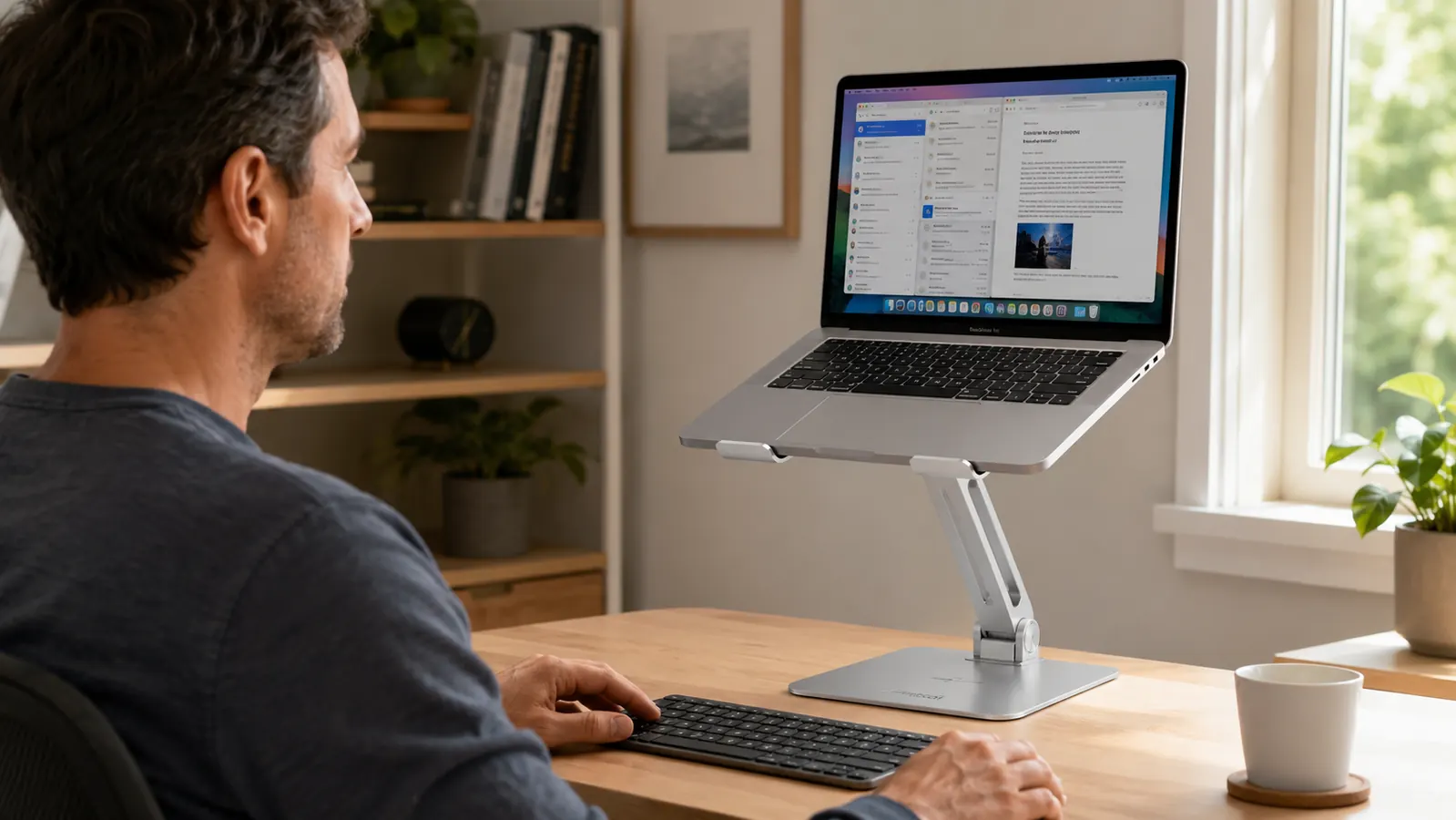
Once your laptop screen is up at eye height, you cannot comfortably type on the built-in keyboard. That is the point. Pairing a stand with a separate keyboard puts your wrists in a neutral, flat position instead of bent upward to reach a raised surface. The combination of a raised screen and a low keyboard is the correct ergonomic setup. The stand is what makes that pairing necessary and natural.
It Stops Your Laptop From Overheating
Laptops ventilate heat from the bottom. When the chassis sits flat on a solid desk surface, that airflow is blocked and the fans work harder to compensate. The Lamicall stand lifts the laptop off the desk completely, leaving a clear gap underneath for air to move through. In practical terms, that means quieter fans, cooler surface temperatures on the keyboard, and less thermal throttling during long video calls or heavy browser sessions.
It Reduces the Shoulder Rounding That a Flat Screen Causes
When you stare down at a flat laptop, your shoulders naturally round forward to follow your head. Over eight hours, that position tightens the pectorals and shortens the muscles across the front of the chest. A raised screen encourages an upright posture where the shoulders sit back in a more open position. The Lamicall is not a replacement for a good chair, but it removes the main posture driver that even a good chair cannot fully correct.
It Frees Up Desk Space You Did Not Know You Were Wasting
A flat laptop claims a full footprint of desk surface. A laptop on a stand uses roughly the same horizontal space but opens up the area directly in front of you at desk level. That is where your notebook, your coffee, your mouse, and your keyboard live. Reclaiming that front-of-desk space makes a real difference on small desks, where every inch matters. The Lamicall's folded footprint is compact enough to hold its position without crowding the desk.
I kept blaming my chair. It turned out the screen height was the problem the whole time. The Lamicall stand costs less than one chiropractic visit and fixed what the chair never could.
It Makes Video Calls Look More Professional
A laptop camera at desk level shoots a view straight up your nose and shows your ceiling. A laptop raised to eye level frames your face at a natural angle, comparable to how a good webcam on a monitor looks. If you are on video calls daily, the stand alone improves how you appear on camera without buying any additional hardware. This is a minor point but it is one that colleagues notice even if they cannot name why.
It Is Stable Enough for a Full Workday, Every Day
Cheap laptop stands wobble when you tap the keyboard and slide when you adjust your monitor angle. The Lamicall uses silicone-padded clamps that grip the laptop's sides and a weighted base that does not shift without intentional force. I have used it daily for ten months and the silicone pads have not degraded. The stand does not feel like it is waiting for an excuse to tip your laptop off the desk.

It Fits Every Laptop and Adjusts in Seconds
The Lamicall holds laptops from 10 to 17 inches. The adjustment mechanism is a single-pull release that lets you move between seven angles without tools. Setting a new height takes about three seconds. If you switch between a work laptop and a personal machine, you are not fussing with screws or adapters. That kind of daily-use simplicity matters more than spec features you will rarely use.
It Is the Cheapest Ergonomic Fix Per Dollar of Benefit
A standing desk converter runs well over a hundred dollars. An ergonomic chair runs two hundred and up. A quality external monitor costs more than that. A laptop stand at around thirty-five dollars delivers the screen-height fix that underlies most neck and shoulder complaints, without the cost or the commitment of a full workstation overhaul. If you are building an ergonomic setup on a limited budget, this is the place to start, not the chair.
It Works With Any Desk, Any Room, Any Workflow
The Lamicall does not require a special desk surface, a mounting clamp, or a dedicated power supply. It sits on whatever you have and does its job. I have used mine on a proper desk, a dining table, and a hotel desk while traveling. The aluminum finish does not look out of place in any of those contexts, and the setup-to-working time is under two minutes from the box. There is no learning curve, no driver, no configuration. You place it, set the angle, and you are done.
What I Would Skip
If you need to use your laptop's built-in keyboard regularly and do not want to add an external one, a laptop stand will create an uncomfortable reach. The stand works best as part of a two-piece setup: riser plus a separate keyboard at desk level. Without the external keyboard, raising the screen also raises the typing surface, which trades neck strain for wrist strain. That is not a win. Get the stand and a basic wireless keyboard at the same time, or wait until you are ready to do both.
I would also skip the cheapest plastic risers in the under-fifteen-dollar range. They flex under the laptop's weight and the height locks do not hold over time. The Lamicall sits in a tier where the aluminum is solid and the mechanism works reliably after months of daily use. That durability gap matters on something you adjust and transport regularly.
Ten months of daily use and the Lamicall still holds its angle on the first try.
Rated 4.8 stars from over 10,000 verified buyers. Adjusts to seven positions, fits laptops 10 to 17 inches, and sets up in under two minutes. If your neck is stiff by noon, this is where to start.
Amazon Check Today's Price on Amazon →