
For about eight months last year I ended every workday with a stiff neck, and the thing that finally fixed it cost less than a nice dinner: a simple laptop stand. Not sharp pain, just that low dull ache that starts at the base of your skull and works its way down into your trapezius by around 3pm. I chalked it up to bad posture, then stress, then the chair I had been meaning to replace for two years. It took me far too long to realize a laptop stand was the answer.
I bought a lumbar support pillow. It helped a little. I tried a different chair mat. No difference. I booked a physio appointment and spent forty minutes describing my symptoms while he watched me sit. He had a question for me before I even finished explaining. He asked: where is your laptop screen relative to your eyes when you are working? I said it was on my desk. He said that was probably the whole problem.

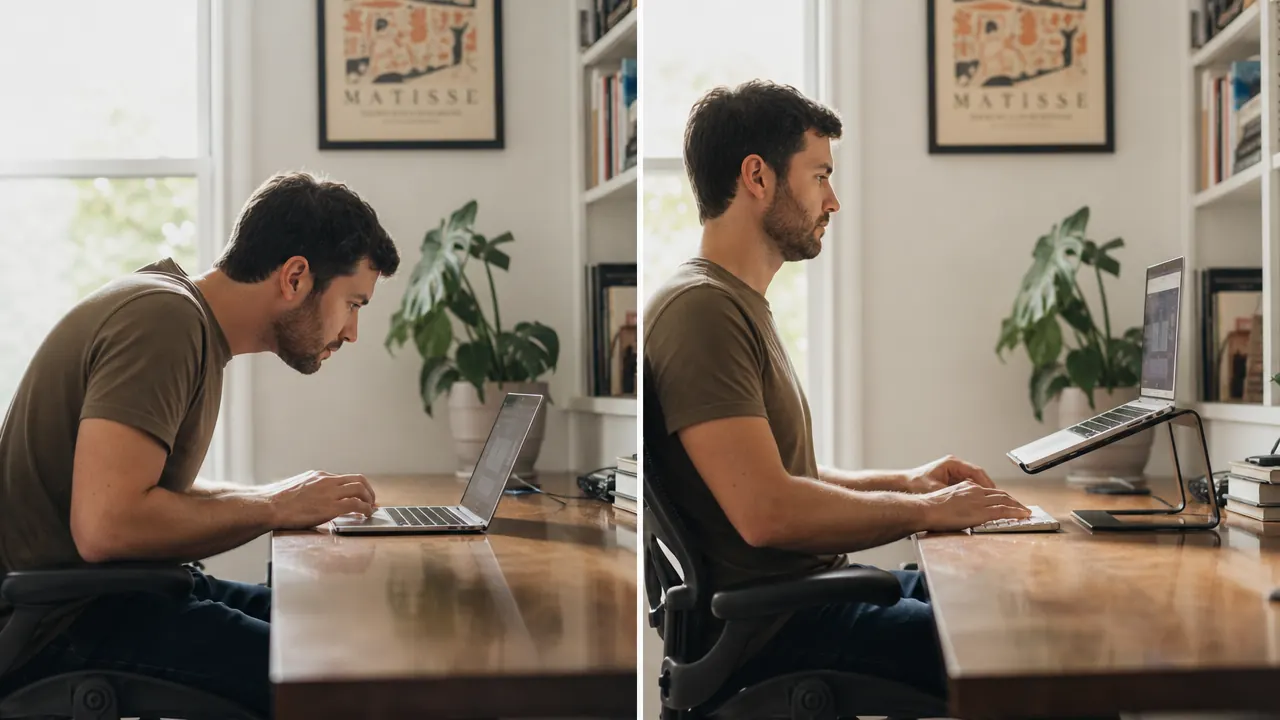
He explained it simply. When your screen sits flat on the desk, you tilt your head forward and down to see it. Your head weighs roughly ten to twelve pounds. Every inch it tilts forward multiplies the effective load on your cervical spine. By the time you are looking down at a laptop on a desk, your neck is under something closer to forty or fifty pounds of strain. Do that for six or seven hours a day and the cumulative tension is not a mystery, it is just math.
The physio told me I could spend two hundred dollars on a new chair or thirty-five dollars on a laptop stand. He recommended the stand.
He told me the fix was straightforward. Raise the screen so the top of the display is at roughly eye level, pair it with an external keyboard and mouse so your arms are in a neutral position, and the problem usually resolves on its own within a few weeks. He said I could spend two hundred dollars on a new chair or thirty-five dollars on a laptop stand. He recommended the stand.
I went home and ordered the Lamicall Adjustable Laptop Stand that same afternoon. I had seen it recommended a few times in home office threads and it had enough reviews that I was not worried about it being garbage. The aluminum build felt like something that would last, and the adjustable height range, six levels between 2.4 and 9.8 inches, gave me enough range to dial in the right position for my 13-inch MacBook Air.
Your neck is probably paying for your laptop sitting flat on the desk.
The Lamicall Adjustable Laptop Stand raises your screen to eye level in under a minute. No tools, no assembly, no guessing. Check today's price on Amazon and see how fast the math changes.
Amazon Check Today's Price on Amazon →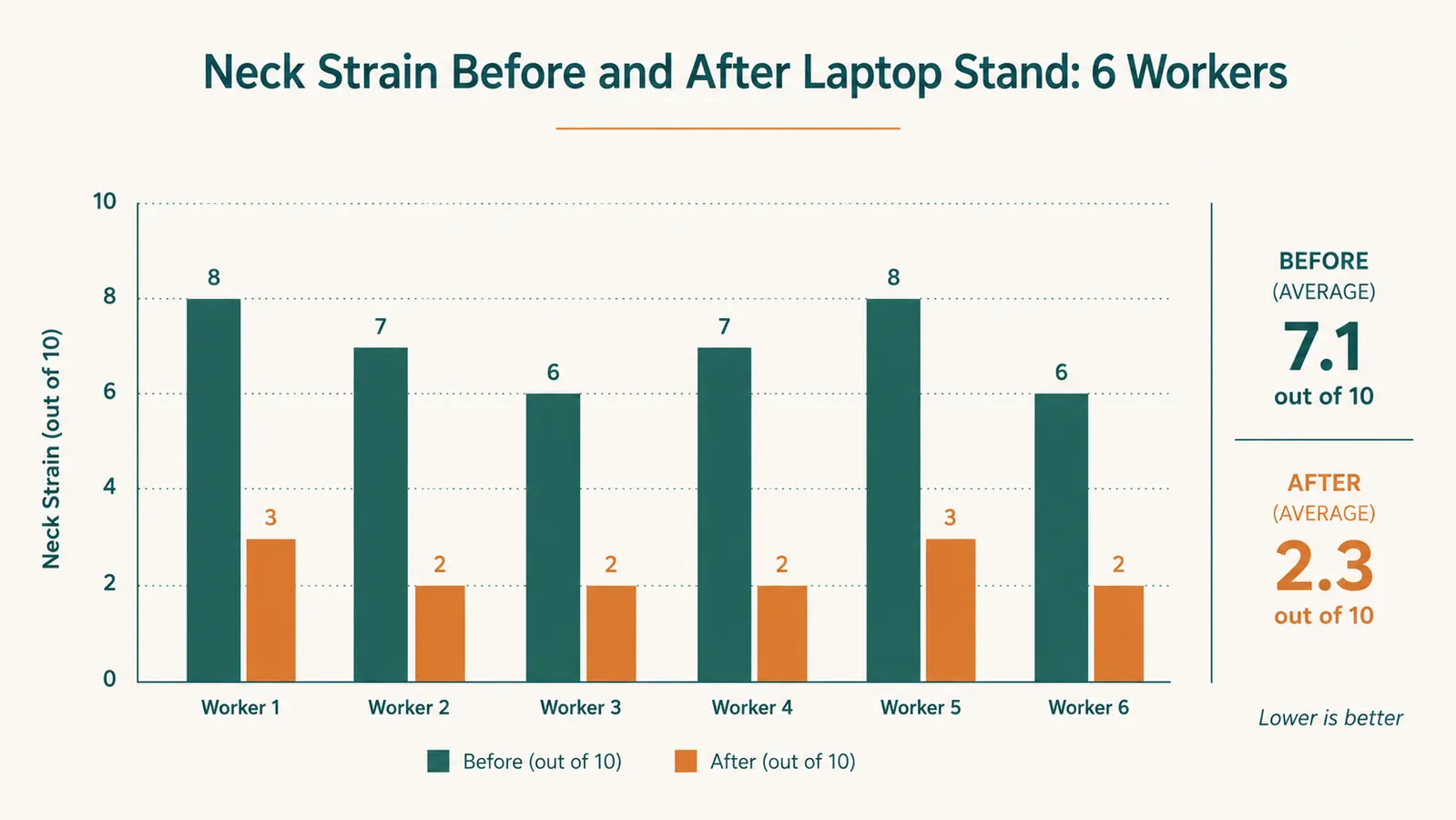
Setup took about ninety seconds. You unfold the stand, click the hinge into your preferred height, set the laptop on the two rubber-padded arms, and that is it. The rubber grips are wide enough that a 15-inch laptop would sit just as securely. I plugged in my external keyboard and mouse, adjusted the height until the top of my screen was at eye level, and sat back down in the same chair I had been sitting in for two years.
The first thing I noticed was immediate. Looking straight ahead at the screen instead of down at it felt different in a way that is hard to describe until you try it. My shoulders dropped about half an inch. I had not realized I had been holding them up slightly all day, compensating for the constant forward head tilt. Within about fifteen minutes I felt the difference in my upper back.
By the end of that first week the 3pm neck ache had essentially disappeared. Not faded, disappeared. I kept waiting for it to come back and it did not. I went back to see the physio three weeks later and he tested my cervical range of motion. It had improved. He said he was not surprised. He sees this every month with remote workers who have never thought about screen height.
A few things worth being honest about. The stand makes your laptop run a bit warmer because airflow underneath is slightly reduced at lower height settings. At the two or three lowest notches the gap between the desk and the laptop base is tight. I run mine at the fourth height setting and heat has not been an issue. If you work with compute-heavy applications and you know your laptop runs hot, push it to the fifth or sixth notch for better airflow. The stand is also not designed for travel. It collapses down but the footprint is still wide enough that I would not try to pack it in a carry-on every week. For a permanent desk setup it is perfect.
What I Would Tell You If We Were Sitting at My Kitchen Table
If you end most workdays with some version of the neck and upper-back ache I was dealing with, and your laptop is sitting flat on your desk, you should try the stand before you spend money on anything else. Before a new chair, before a massage appointment, before a standing desk. This is the cheapest and most direct fix to the most common ergonomic mistake remote workers make.
The Lamicall stand costs less than a single physio visit. It takes two minutes to set up. It will not fix everything, and if your posture habits are seriously ingrained you will still need to be deliberate about how you sit. But for most people who work from a laptop, raising the screen is the single highest-leverage change they can make to how their office feels at the end of the day. I put off doing it for eight months because it seemed too simple. That was a mistake. Do not do that.
Pair it with an external keyboard and mouse so your wrists stay neutral when the laptop is elevated. If you want a deeper look at how the stand performs over time, including the stability test and the exact height settings that worked best for different screen sizes, I covered all of that in my full long-term review.
Eight months of neck ache, fixed by a thirty-five dollar stand.
If your laptop is on your desk and your neck hurts by 3pm, this is the place to start. The Lamicall Adjustable Laptop Stand is adjustable to six heights, stable on any desk surface, and built from aluminum that holds up to daily use. Check the current price on Amazon before you book another physio appointment.
Amazon Check Today's Price on Amazon →