

I spent three years telling myself my wrist ache was just part of writing for a living. A flat keyboard, arms squeezed in toward my sides, wrists canted outward at an angle nobody in a physio textbook would recommend. The discomfort was dull and constant and I had basically accepted it. Then I switched to a split ergonomic keyboard and within two weeks the ache was gone. Not managed. Gone. If you have been typing on a straight keyboard for years and your wrists, forearms, or shoulders bother you by mid-afternoon, the geometry of your keyboard is likely the cause. Here are ten specific mechanical reasons a split design changes that.
The Logitech Ergo K860 is the keyboard I switched to after testing two cheaper split options that did not stick. It is wireless, has a built-in wrist rest with a wave curve, and the split angle is fixed at a position that worked immediately for my shoulder width. With over 7,900 Amazon ratings averaging 4.5 stars, it is the most-reviewed split keyboard in this price tier for good reason. Every reason below draws on how the K860 specifically handles the problem.
Wrist ache by 2pm? The K860 changes the geometry that causes it.
The Logitech Ergo K860 is the split ergonomic keyboard I switched to after two failed attempts with cheaper alternatives. Wireless, built-in wrist rest, immediate comfort improvement for shoulder-width typing.
Amazon Check Today's Price on Amazon →It Lets Your Arms Stay at Shoulder Width
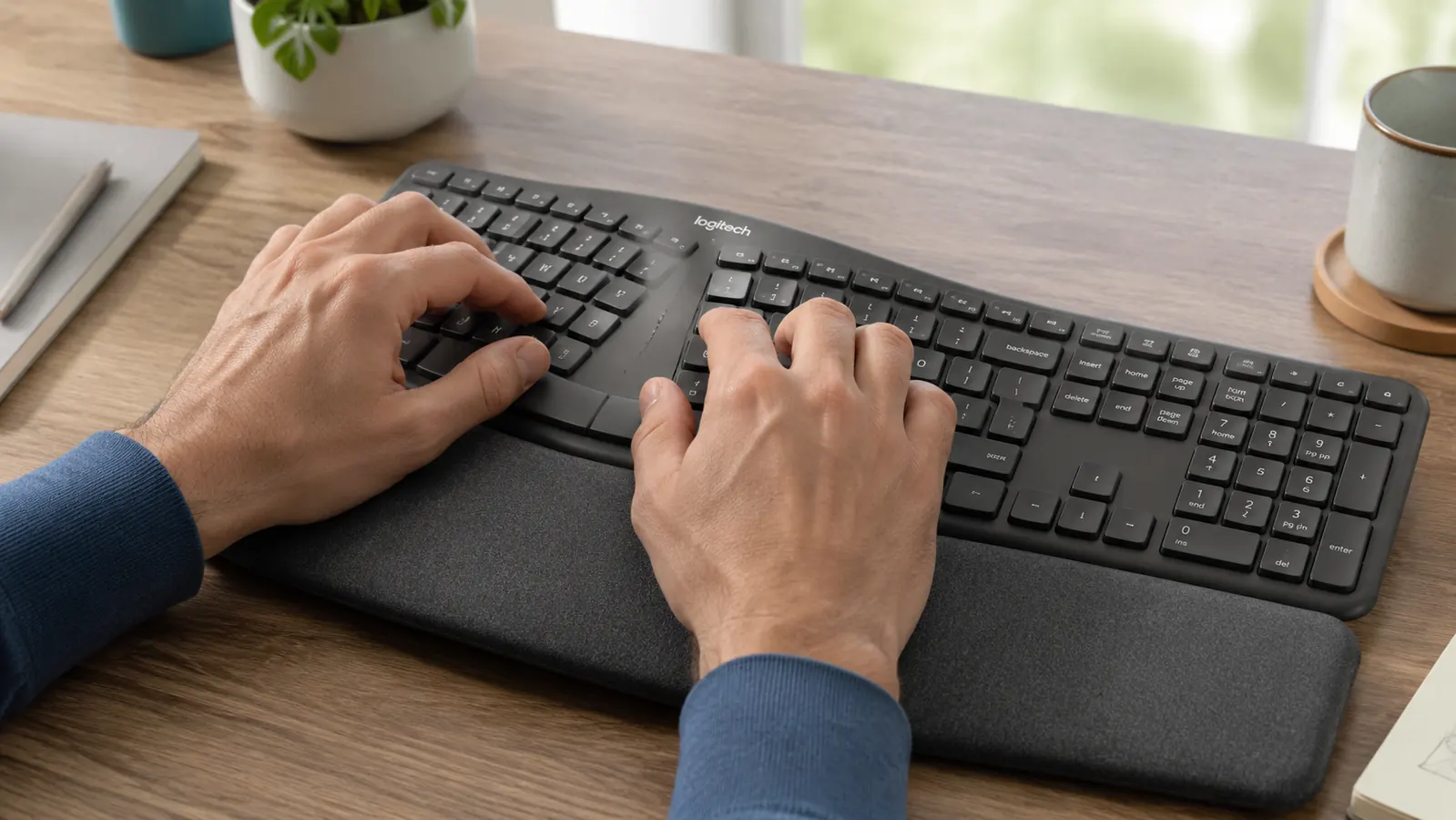
A flat keyboard forces your hands to meet in the middle of your body, which means your elbows are pulled inward and your shoulders rotate forward and inward too. Do that for eight hours and your upper back, neck, and shoulders pay for it. A split keyboard like the K860 lets each half sit where your hands naturally fall when your arms hang relaxed at your sides. That small adjustment removes constant tension from the muscles across your shoulders and upper back.
It Eliminates Ulnar Deviation
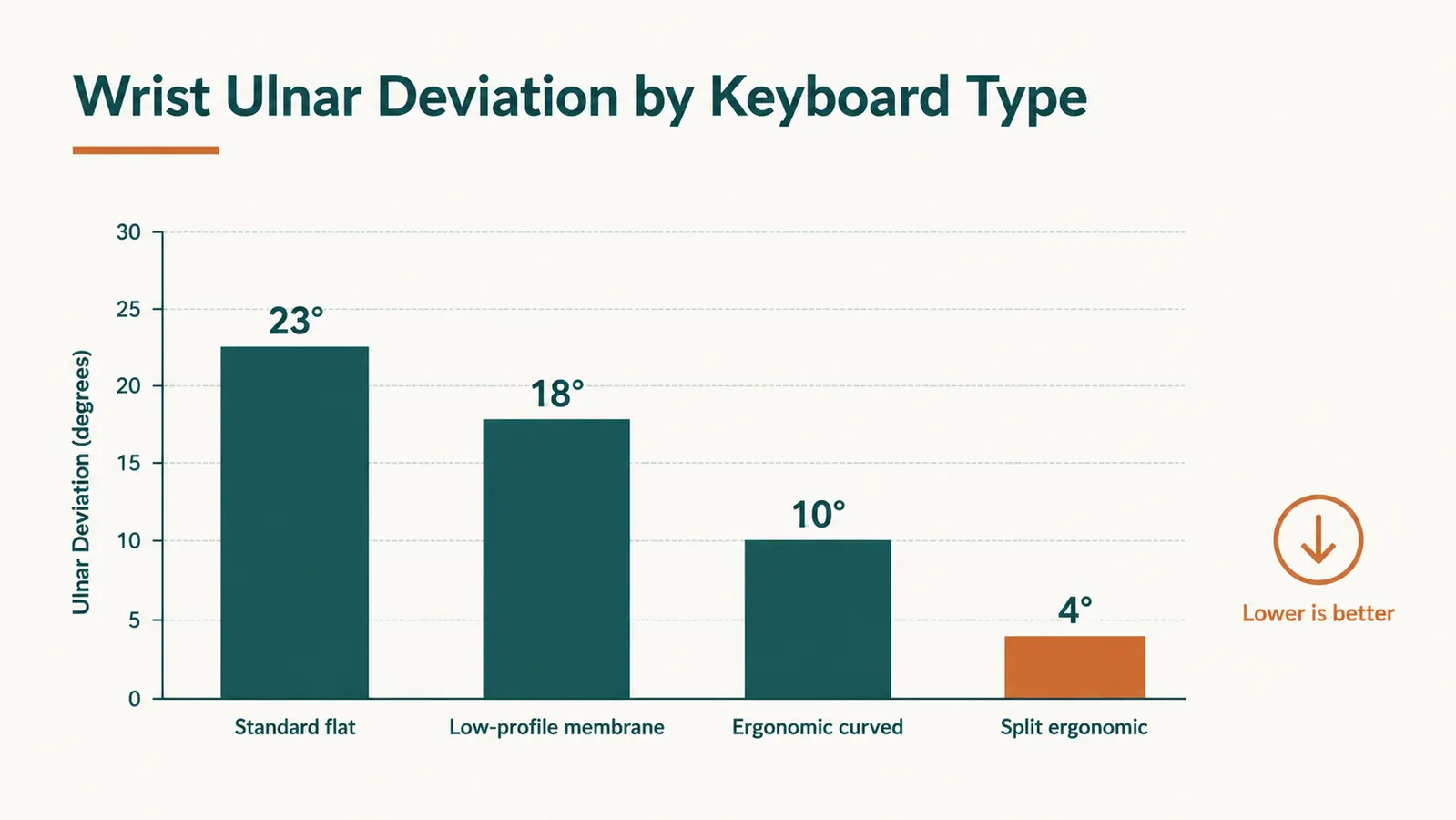
Ulnar deviation is what happens when your wrists angle outward to reach a flat keyboard that is narrower than your shoulder width. That bent-wrist position compresses tendons and nerves over time. A split keyboard removes the need for that angle entirely. Your wrists can stay straight and neutral because the keyboard comes to your hands rather than making your hands come to it. This alone is the single biggest mechanical fix a split board provides.
The Negative Tilt Reduces Wrist Extension
Most flat keyboards sit level or with a positive tilt (back edge raised), which forces you to extend your wrists upward as you type. Wrist extension is a documented carpal tunnel risk factor. The K860 uses a negative tilt, meaning the front edge is slightly elevated and the keys slope gently away from you. Your wrists stay flatter and more neutral. It feels odd for about a day and then it feels like the only sensible way to type.
The Integrated Wrist Rest Supports the Right Spot
A wrist rest that sits at the wrong height or angle can actually make things worse by creating a pressure point on the carpal tunnel area. The K860's curved foam rest is contoured to cradle the palm of your hand at the base of the wrist, not the wrist joint itself. The wave shape also accounts for the fact that your left and right hands are at different natural angles. After months of use the foam has not compressed to flat, which is a real problem with cheaper aftermarket rests.
A split keyboard does not ask you to adapt to it. It adapts to the width your body already has.
It Reduces Forearm Pronation
When you type on a flat keyboard with your palms facing the desk, your forearms are in full pronation, which stretches and tenses the muscles of the forearm all day. Some split keyboards, and more extreme tented models, let you rotate each half to reduce pronation. The K860 does not tent, but its fixed split angle already removes enough inward rotation to reduce pronation strain noticeably versus a flat straight board. If your forearms fatigue and ache by mid-day, this is the mechanism responsible.
The Curve Shortens the Distance to Home Row
The K860's key layout follows a curved arc rather than sitting in perfectly flat rows. The result is that every key is closer to the home row position your fingers rest in. You stretch less to reach number keys, function keys, and outer letter keys. Less stretching means less tendon stress per keystroke, multiplied by thousands of keystrokes a day. For writers and coders who spend full workdays typing, that cumulative reduction matters.
It Trains Better Typing Posture Passively
Most ergonomic advice is active: remember to sit up straight, remember to take a break, remember to adjust your monitor. A split keyboard improves your posture passively just by being the shape it is. When your arms are correctly positioned to use the keyboard, your spine tends to follow. It is not magic. It is just that fixing the geometry at the hands propagates upward through the kinetic chain. I noticed my shoulder hunching improved after about a week, without consciously working on it.
Wireless Removes the Cable-Position Compromise
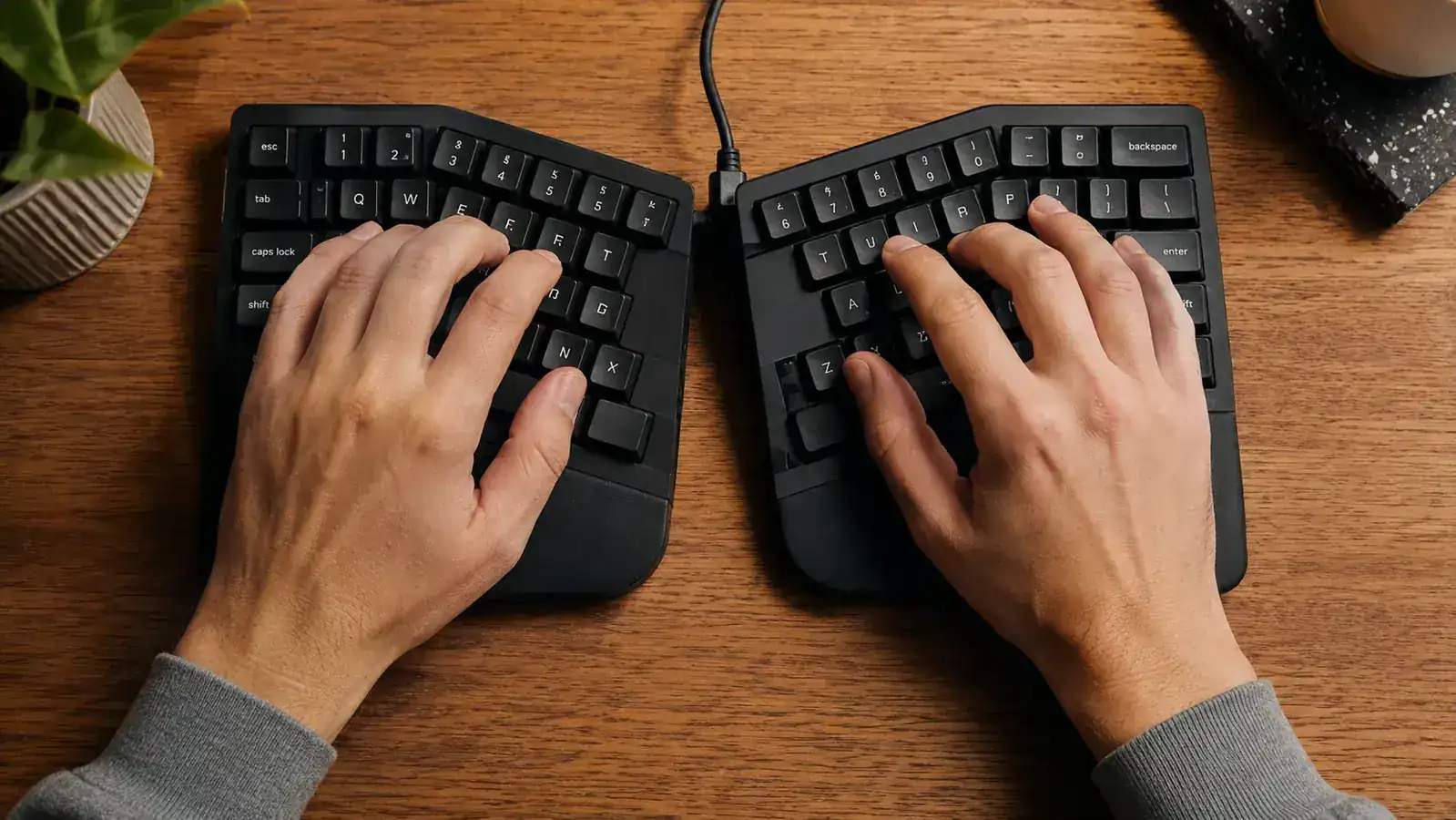
A wired keyboard forces you to place it wherever the cable reaches comfortably, which is often not exactly where your arms want it. The K860 connects wirelessly via Unifying USB receiver or Bluetooth and handles up to three devices. You can place it wherever your hands naturally fall without routing a cable around monitors, stands, or desk organizers. That placement freedom sounds minor until you realize how many small ergonomic compromises you make daily to accommodate cable management.
It Works With a Laptop Stand Setup Without Cramping
If you use a laptop stand to raise your screen to eye level, you already have an external keyboard. Pairing a flat keyboard with a stand is better than typing on the laptop, but you are still forcing the same inward-wrist position. Pairing a laptop stand with the K860 is the complete ergonomic solution: screen at eye level, keyboard at the correct width, wrists neutral. The combination addresses the two main posture complaints I hear from remote workers, neck strain and wrist strain, simultaneously. See the full guide on how to set up an ergonomic keyboard in your home office for the exact measurements.
The Learning Curve Is Real But Short
Switching to a split keyboard costs you typing speed for the first one to two weeks. The split layout exposes any bad habits you built on a flat board, usually hitting keys with the wrong hand. My speed dropped noticeably for about ten days and then came back to normal and then slightly exceeded it. If you type correctly to begin with, the adjustment is faster. If you do not, the K860 will break the habit. That short discomfort is the honest trade for years of reduced wrist and shoulder strain. Read the full Logitech K860 year-long review for detail on the adjustment period week by week.
What I Would Skip
If you are a gamer who relies on precise left-hand key positioning for WASD controls, the K860 is not for you. The split layout and curved rows change the key positions enough that gaming controls become awkward. It is strictly a productivity keyboard for writing, coding, spreadsheet work, and general office use. I would also skip it if you type fewer than three to four hours a day. The ergonomic benefit compounds with volume, and if your daily typing load is light, a flat keyboard with a good wrist rest may be all you need.
Ready to stop accepting wrist pain as part of the job?
The Logitech Ergo K860 is the split ergonomic keyboard that solved three years of dull wrist ache for me. Wireless, 4.5 stars across 7,900+ reviews, and a built-in wrist rest that actually holds its shape. Check current pricing and availability on Amazon.
Amazon Check Today's Price on Amazon →