
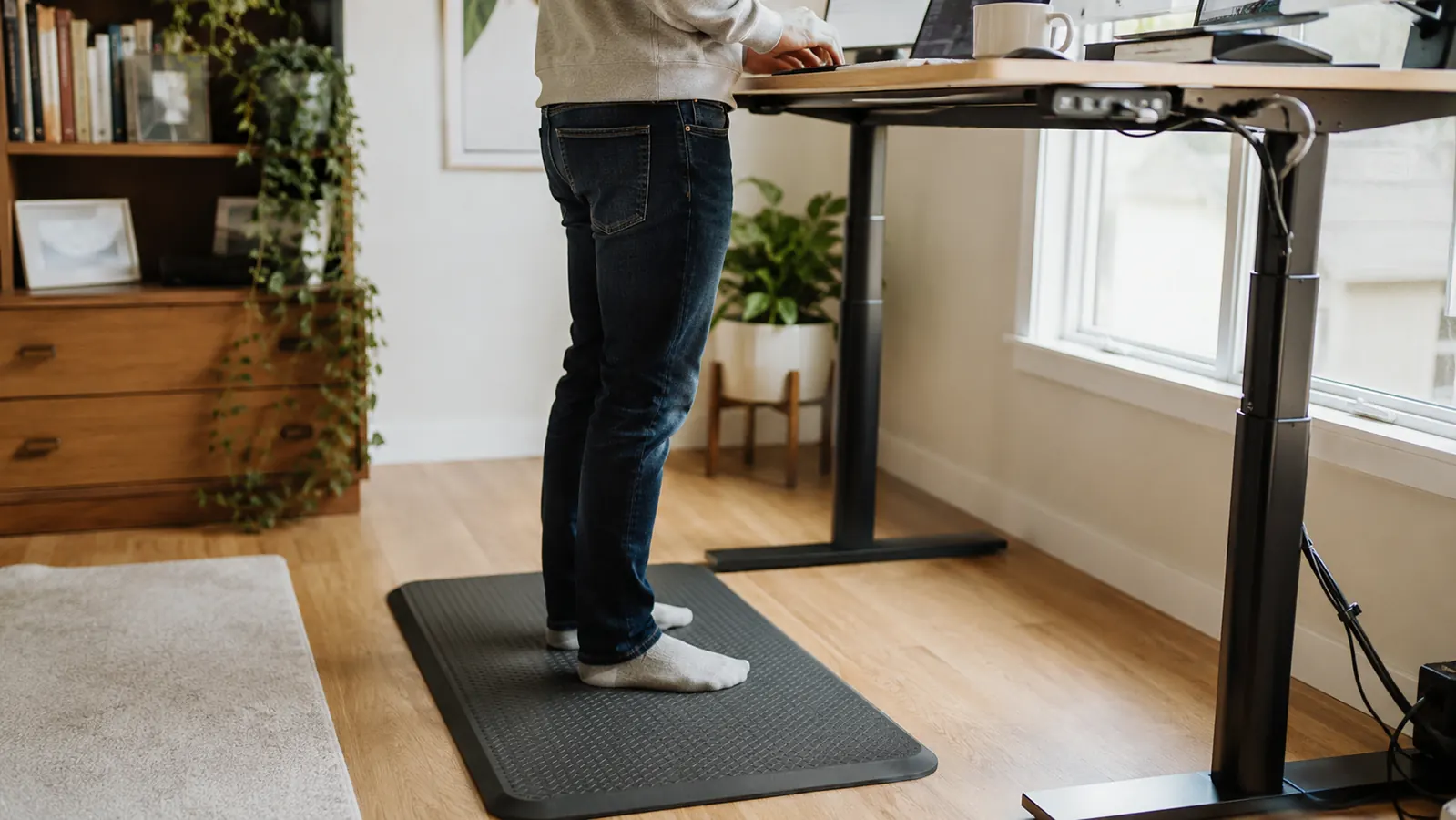
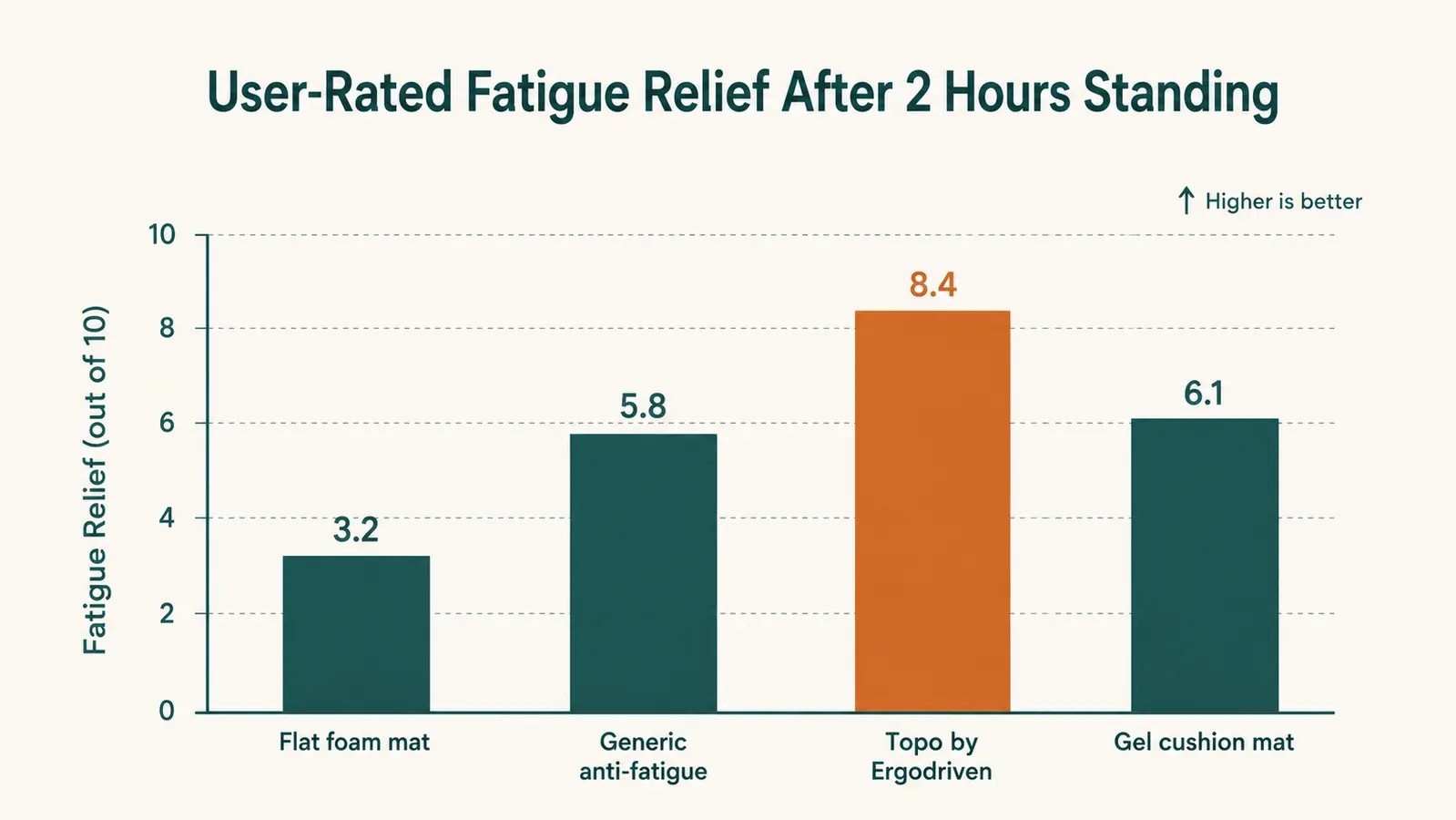
The Ergodriven Topo is the standing mat that gets recommended in every home office subreddit, every ergonomics guide, and every list article about standing desk accessories. It has nearly six thousand reviews on Amazon and a 4.7 rating. So why does it also have a notable cluster of one-star reviews from people who immediately returned it? I bought it, I have used it, and I want to give you the answer to that question before you hand over the money. This is not a writeup about whether the Topo works. It does. This is a writeup about everything the product page and the five-star reviews skip over.
If you want the long-term daily-use verdict, that is a separate article covering twelve months of standing on it. This one is specifically for people standing at the Amazon listing right now trying to decide whether to click Buy. I am going to walk you through the five things I wish someone had told me, and then give you a straight answer on who should spend the money and who should not.
The Quick Verdict
The Topo earns its reputation, but it has a real smell on arrival, a two-week learning curve most buyers are not warned about, a sizing decision that trips up a lot of people, and a cleaning situation that requires attention every few weeks. None of that makes it the wrong buy for daily standing desk users on hard floors. It does mean you should go in with accurate expectations.
Amazon Check Today's Price →Still standing on the fence? The Topo's current price has moved enough in the past year to change the calculus.
Before you decide, check what it is actually selling for today. The standard size and the large size have different price points and the gap matters if you are comparing it to a flat mat alternative.
Amazon Check Today's Price on Amazon →How I've Used It and Why I'm Writing This
I write remotely full time and I stand at my desk using a converter for roughly two to two and a half hours on a typical workday. My floor is hardwood throughout. I had used two flat anti-fatigue mats before the Topo, neither of which solved the afternoon foot fatigue I kept running into. I bought the Topo standard size about fourteen months ago and have used it daily since. I did not have a smooth first two weeks with it. That experience, and several conversations with people who returned it, is exactly why I wanted to write this.
What follows is not a list of flaws that disqualify the mat. It is the information gap that exists between a product page and real daily use. Every item on this list is something I either experienced myself, saw in detailed one-star reviews from verified buyers, or heard directly from remote workers who either returned it or almost returned it before sticking with it.
Thing One: The Smell Is Real and It Takes Longer Than You Expect
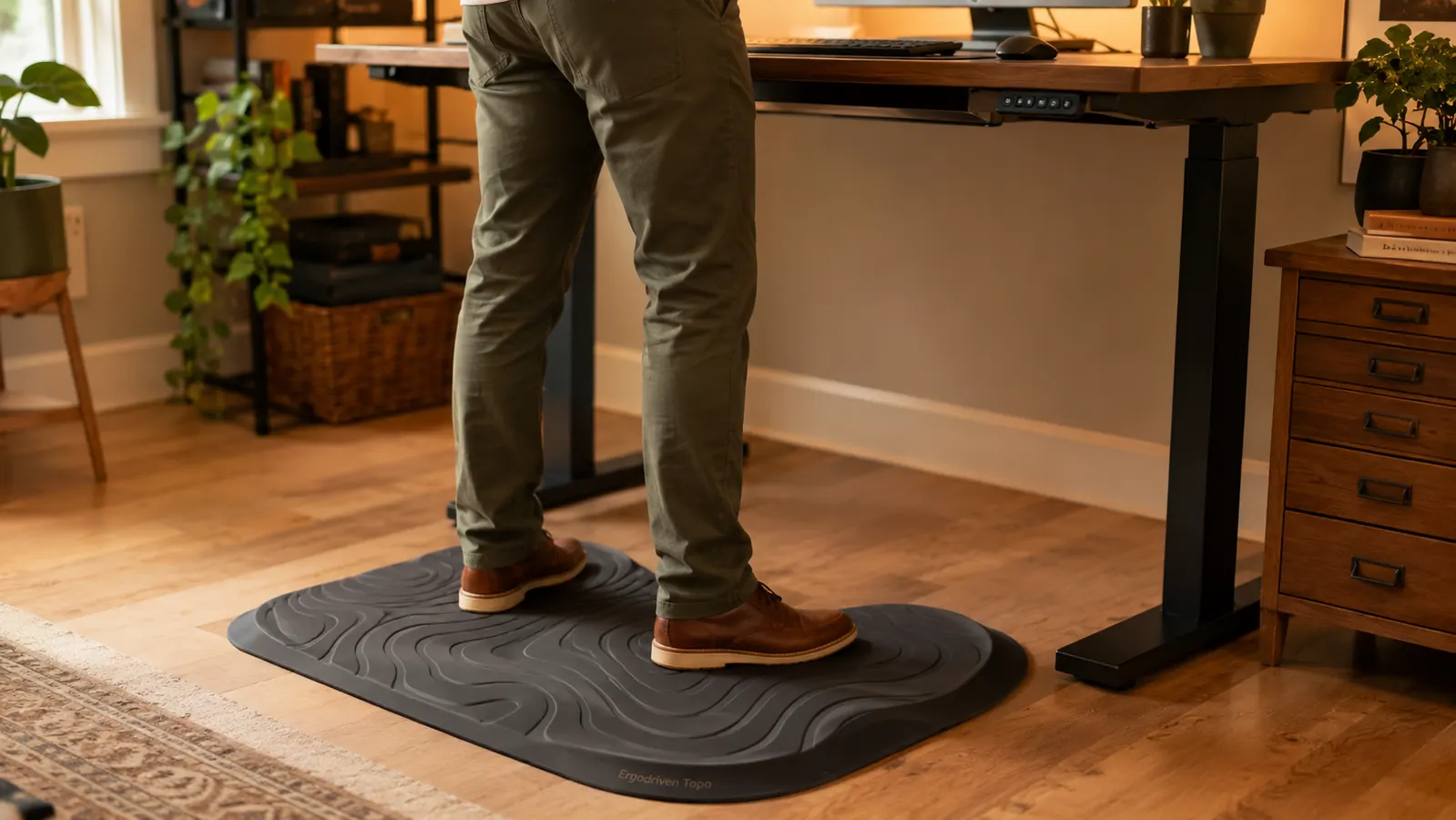
The Topo arrives smelling strongly of rubber. This is not a faint chemical note you have to get close to detect. It is a genuine, fill-the-room rubber smell that is present from the moment you open the box. Ergodriven and the reviews both mention this briefly, usually in a line that says something like 'mild odor that dissipates quickly.' That undersells it.
In my experience the strong smell lasted five full days before I stopped noticing it. I keep my home office well ventilated and that likely helped. People who work in smaller rooms with less airflow have reported the smell lasting ten days to two weeks before it dropped to a genuinely ignorable level. If you are smell-sensitive or if your home office is a small enclosed room, this is worth factoring in. Open a window for the first week. Do not unbox it on a Friday afternoon and expect it to be unnoticeable by Monday morning.
The good news: the smell goes away completely. I have not detected it since the first week. There is no ongoing off-gassing issue once it clears. This is a first-week problem, not a long-term problem. But it is a real first-week problem that the positive reviews consistently minimize.
Thing Two: The Sizing Decision Is More Important Than the Listing Suggests
The Topo comes in two sizes: standard at 26 by 29 inches, and large at 30 by 35 inches. The listing makes this sound like a minor preference call. It is not. If you get the wrong size for your standing setup, the mat will frustrate you in a specific and consistent way that has nothing to do with the design itself.
The standard size is the right choice for most single-person home office standing setups. It gives you enough lateral room to shift weight without stepping off the mat, and it keeps the footprint compact in front of your desk. The large size is designed for people who spend very long periods standing, want more variety in foot positions, or are using the mat at a wider workstation. Several buyers who ordered large and then returned the mat cited the size as the reason: it felt awkward and took over too much floor space in a typical home office with limited depth between the desk and the chair.
Going too small is the opposite problem. If you have very long feet (above a US size 12) or if you tend to stand with a very wide stance, the standard size can feel constrictive. The lateral edge drops off quickly enough that you step off the mat more often than you should. My honest recommendation: if you are buying for a standard home office desk and your shoe size is below a 12, buy the standard. If you are a larger-framed person who stands with a wide natural stance, consider the large. Do not buy the large because you think more is better.
Thing Three: The Learning Curve Is Real and It Has a Frustration Window
The Topo's raised dome and sloped terrain feel unstable under your feet for the first several days. This is the thing that drives the returns. If you stand on this mat on day one and compare it to standing on a flat mat, the flat mat will feel more comfortable. That comparison is not useful, but it is the comparison your brain makes automatically.
What is actually happening is that the contoured surface is asking your feet and lower legs to engage muscles they have not been using during static flat standing. The mild instability is not a design flaw. It is the mechanism that creates the micro-movement benefit. But for roughly days three through seven, before your feet have adapted, the mat can feel like something is wrong with it. Some people interpret that feeling as proof it is the wrong product and return it during that window.
If you stand on the Topo on day one and compare it to a flat mat, the flat mat wins. Give it ten days. The comparison reverses completely.
The adaptation window is roughly ten to fourteen days for most people. By the end of that window you stop consciously thinking about your foot placement and start shifting weight naturally. If you are in the first week and it feels awkward, that is normal. If you are at week three and it still feels actively uncomfortable, then the contoured design may genuinely not be right for your body mechanics, and returning it is a legitimate call. Ergodriven has a return policy worth checking before you buy. But do not make the return decision at day five.
Thing Four: Barefoot, Socks, or Shoes Changes the Experience Significantly
Nobody on the product page or in most reviews tells you that the footwear question matters for the Topo in a way it does not for flat mats. On a flat foam mat, it barely matters whether you are barefoot, in socks, or in shoes. On the Topo, it matters more.
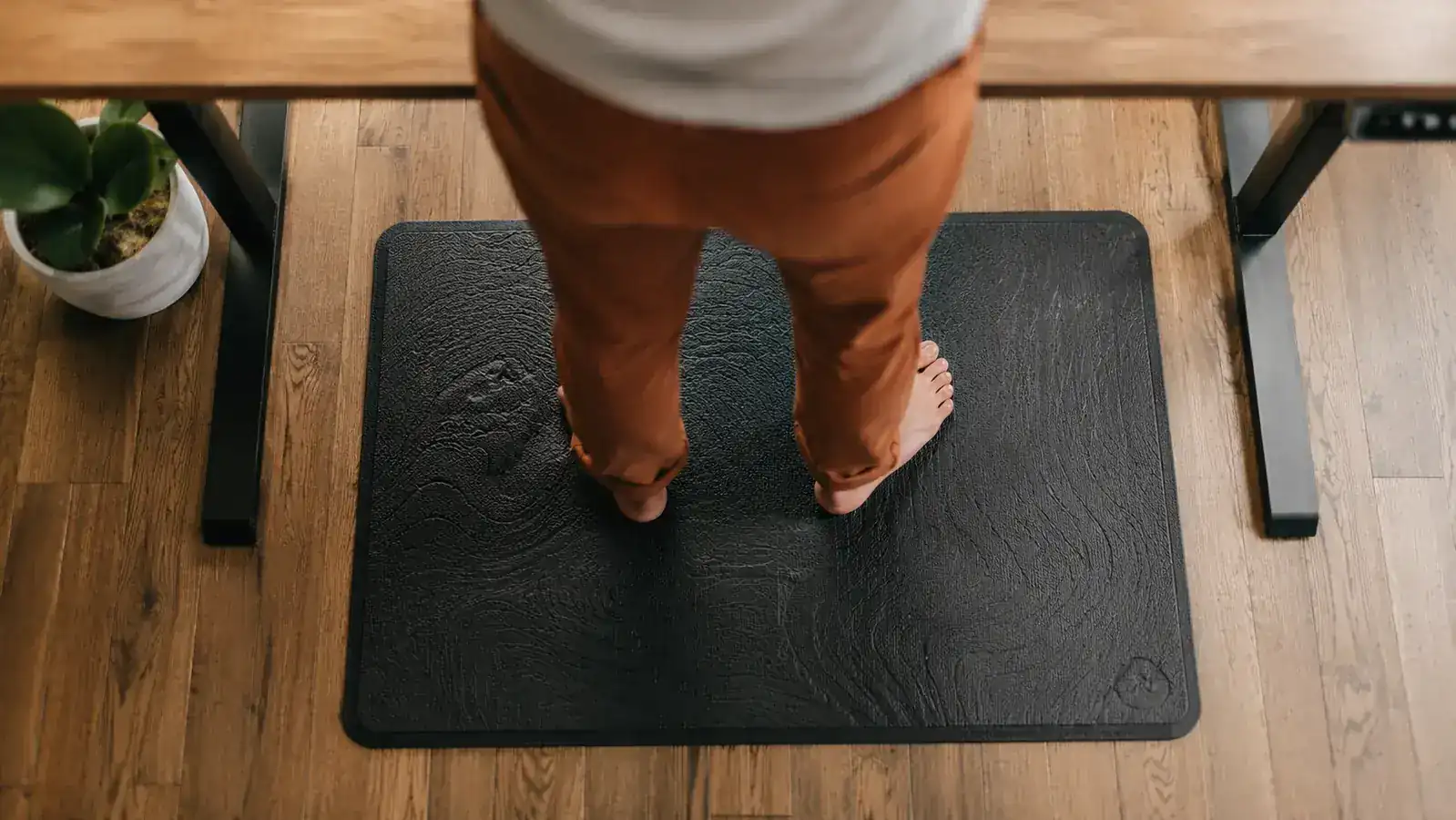
Barefoot on the Topo gives you the most sensory feedback from the terrain. Some people find this grounding and pleasant. Others find the texture of the surface slightly rough against bare skin. Socks are the sweet spot for most users: you get the proprioceptive benefit of feeling the dome and slopes, and the socks provide enough of a buffer that the surface texture is not an issue. Shoes change the experience in a more significant way: thick-soled shoes dampen the terrain feedback enough that the Topo starts to feel more like a slightly uneven flat mat. It still provides more cushioning than hard floor, but a lot of the postural micro-movement benefit is reduced.
If you are planning to use the Topo in shoes because you work in a shared space or have a home office policy about footwear, the mat still works. But you will get less of the benefit the design is built around. Socks or barefoot is how this mat performs as intended.
Thing Five: Cleaning Requires a Real Routine
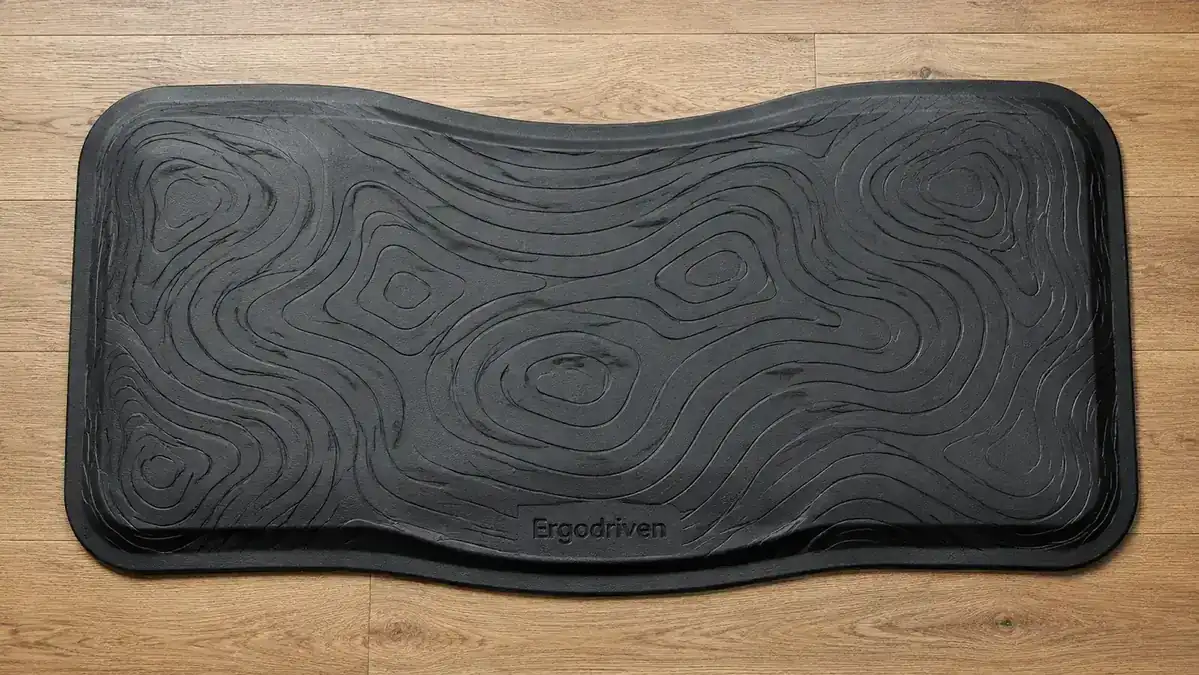
The Topo's textured surface accumulates dust, hair, and foot debris in the same way any other floor-level surface does. The difference from a flat mat is that the terrain gives debris places to collect and lodge that a quick floor sweep does not reach. Specifically, the groove where the dome meets the surrounding surface and the crease at the base of the sloped edges trap lint and hair in a way that becomes visible within a couple of weeks of daily use.
A damp cloth or a slightly damp sponge handles most of it. This takes maybe three minutes every ten to fourteen days if you stay on top of it. The problem is that the textured surface means you cannot just wipe in one direction. You have to work the cloth into the contours. People who let it go for a month find the cleaning job significantly more involved. A lint roller gets the surface debris between deeper cleans and adds maybe thirty seconds to your weekly tidying.
None of this is deal-breaking. But if you read the positive reviews looking for maintenance information, you will mostly find silence on the subject. The cleaning reality is a routine you build into your workspace upkeep, not something you can ignore.
The Price: What You Are Actually Paying For
The Topo costs meaningfully more than a flat anti-fatigue mat. The cheapest credible flat mats run in the twenty to thirty dollar range. A mid-tier flat mat from a known brand is forty to sixty dollars. The Topo sits well above both of those price points. That gap is real and it is worth being direct about.
What the premium buys you is not just different materials. It is the contoured terrain design, the specific foam formulation that resists compression over time better than standard memory foam, and the durability that makes this a multi-year purchase rather than something you replace every eight months. If you stand daily for two-plus hours on hard floors, the cost per month of ownership over two or three years is actually lower than the cheap flat mats you would cycle through in that time. If you stand less than forty-five minutes a day, that math changes considerably and a mid-tier flat mat is probably the smarter buy.
What I Liked
- Contoured terrain actively reduces foot and calf fatigue in a way flat mats cannot replicate
- Durable foam resists compression and holds its shape under daily heavy use
- Non-slip base stays put on hardwood and tile floors without shifting
- No ongoing odor issue after the first week clears
- Standard size fits most single-workstation home office setups without taking over the floor
- Returns to looking clean with a damp cloth every couple of weeks
Where It Falls Short
- Rubber smell on arrival is stronger and lasts longer than most reviews indicate
- Learning curve of ten to fourteen days before the terrain feels natural, not awkward
- Sizing options are not explained well: buying the wrong size is a common and avoidable mistake
- Thick-soled shoes reduce the micro-movement benefit significantly
- Textured surface requires deliberate regular cleaning to stay looking good
- Price is a genuine barrier if you are still testing whether you will commit to standing daily
What the One-Star Reviews Are Actually Telling You
I read through the one-star reviews on the listing before writing this. The majority of them fall into one of three categories. First: the buyer ordered the wrong size and found it too large or too small for their setup. Second: the buyer used it for three to five days, found it uncomfortable compared to a flat mat, and returned it before the adaptation window closed. Third: the smell was worse than expected and the buyer was in a small room with poor ventilation. All three of those are legitimate experiences. None of them indicate a defective product.
There is a smaller cluster of one-star reviews from people who used it for several months and found the dome eventually bothersome, or who found the mat too firm for their particular foot condition. Those are real product-fit mismatches. If you have plantar fasciitis, a very high arch, or significant heel pain, the Topo's firmness is worth researching specifically for your condition before buying. Some people with plantar fasciitis do very well with it. Others find the dome placement aggravates their heel. That is not a universal dealbreaker, but it is something to look into if foot pain is already part of your picture.
Who This Is For
The Topo is the right buy if you are a committed daily standing desk user who works on hard floors, already knows you will stand for at least an hour a day, and wants to invest in a mat that will last. It is also the right call if you have already tried a flat mat and found it insufficient. The smell does not last, the learning curve is real but short, the sizing decision is easy if you read the dimensions carefully, and the cleaning is manageable if you make it a routine. Over a multi-year ownership period the cost is defensible compared to cycling through cheaper flat mats.
Who Should Skip It
Skip the Topo if you are still in the experimental phase of standing at your desk and not sure whether you will stick with it. Buy a twenty-five dollar flat mat first and confirm the habit before committing to the Topo's price point. Skip it if you work in a poorly ventilated space and smell sensitivity is high, at least until you can plan for proper airflow during the first week. Skip it if you wear thick-soled shoes exclusively in your home office and refuse to use socks or go barefoot, because the terrain benefit is largely lost on you. And skip it if you have a specific foot condition that responds poorly to firm uneven surfaces, without first consulting someone who knows your situation.
You now know the smell, the sizing trap, and the learning curve. If none of those are dealbreakers, the Topo is worth every dollar.
Check the current price for the standard and large sizes before you decide. The gap between them has shifted in the past year, and knowing both prices makes the size decision much easier.
Amazon Check Today's Price on Amazon →